Japan Display (JDI) plans to start producing medium-sized OLED displays, to be used in tablets and laptops. The company hopes to start producing the first panels (which will be around 14-inch in size) by 2025.
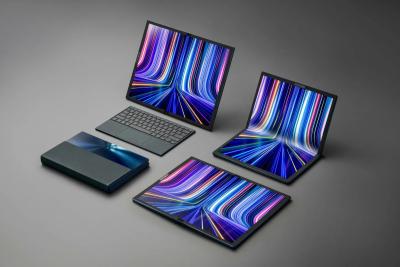
Asus ZenBook 17 Fold OLED (BOE panel)
Up until now, JDI focused on the production of wearable OLED displays, selling its panels for Apple's smartwatches since 2019. The company's production volume was limited, and so was its technology capabilities to increase production panel sizes. It will be interesting to see whether JDI hopes to also supply its future laptop/tablet panels to Apple.
With its new eLEAP deposition technology, however, JDI hopes to be able to produce high-performance laptop-sized AMOLED displays at a lower cost compared to current production technologies used by other OLED makers (FMM). JDI decided to convert its Mobara OLED production site to eLEAP technology - but it did not decide yet whether the Mobara plant will continue to produce only wearable displays, or will it also be used to produce the laptop-sized displays. JDI's other option is to start laptop OLED panel production the company's Chinese partner, HKC.
In 2022, Japan Display (JDI) announced that it has developed a "historic breakthrough in display technology" - a new OLED deposition process which they refer to as eLEAP, that is said to be cost effective and can be used to create freeform OLEDs that are brighter, more efficient, and longer lasting compared to OLEDs produced using mask evaporation (FMM).

In April 2023, China-based LCD maker HKC Corp has signed an agreement with JDI to adopt its technology for mass production of AMOLED displays. Under the agreement HKC will invest billions to build AMOLED factories in China, while JDI will provide the manufacturing expertise and technologies, including eLEAP. The plan is to begin mass production in 2025, with the first applications to be in automotive displays and wearable devices.
HKC, was established in 2001, and has three LCD production sites in Chongqing, Chuzhou and Mianyang. The company is one of the world's largest LCD makers, with an estimated market share of around 10% from the global TV ppanel market (and around 6.5% of the global display industry as a whole).
Japan Displays established in 2011 by the merger of Sony's, Toshiba's and Hitachi's display businesses and funded by Japan's government fund Innovation Network Corporation (INCJ). The company was late to realize the importance of OLED production and has struggled financially for many years. It announced a strategic focus on OLED displays in 2017, but never managed to gain major mass production capabilities. The company started to produce OLED displays in 2019, but with low volume. It managed to gain Apple as a customer for Watch wearable displays. This new partnership with HKC could be great news for the company, finally gaining access to the vast amounts of money required to mass produce AMOLEDs.
eLEAP is based on a lithographic method, and does not require any masks. The main advantage seems to be that OLED displays produced by eLEAP technology can achieve an aperture ratio of 60%, compared with FMM OLEDs which achieve a ratio of about 28%. This means that the OLED displays can be driven at lower currents - which extends the lifetime, improves the efficiency and also enables higher-peak brightness when needed.
JDI claims that eLEAP displays offer a boost of 2X in emission efficiency and peak brightness - while lifetime is extended by of 3X (which also reduces burn-in problems). These numbers, if accurate, are highly impressive. JDI is using a 300PPI display for these calculations.
eLEAP stands for environment positive, Lithography with maskless deposition, Extreme long life, low power, and high luminance, and Any shape Patterning. JDI says that eLEAP can be combined with the company's HMO (High Mobility Oxide) backplane technology to dramatically improve OLED display performance. eLEAP production technology can be scaled up to 8-Gen (2200x2500 mm) substrates - or even larger, and is suitable for OLED display production from wearable-size displays to TV sizes.
Finally, JDI says that eLEAP reduces operating costs, reduces material waste and does not require cleaning fluids for the masks - which means that eLEAP significantly reduces material usage, waste and CO2 emissions.
In 2022 it was reported that Samsung Display is interested in JDI's eLeap technology, but this wasn't confirmed since then.
Comments
That's a great question. eLEAP's main performance advantage is the high aperture ratio. I would assume it's quite compatible with a tandem architecture. It's likely that if everything works as JDI says it does, an eLEAP display will be easier and cheaper to produced compared to a tandem device.


It seems the eLEAP technology performances (efficiency, lifetime improvement) are close to the tandem-stack performances ?
What are the trade-offs of each one ?
Would it be possible to combine them both, by doing an eLeap tandem-stack to even further increase efficiency and lifetime improvement ?