Maskless OLED production

LG Display to brand its maskless OLED production process as FLiPP

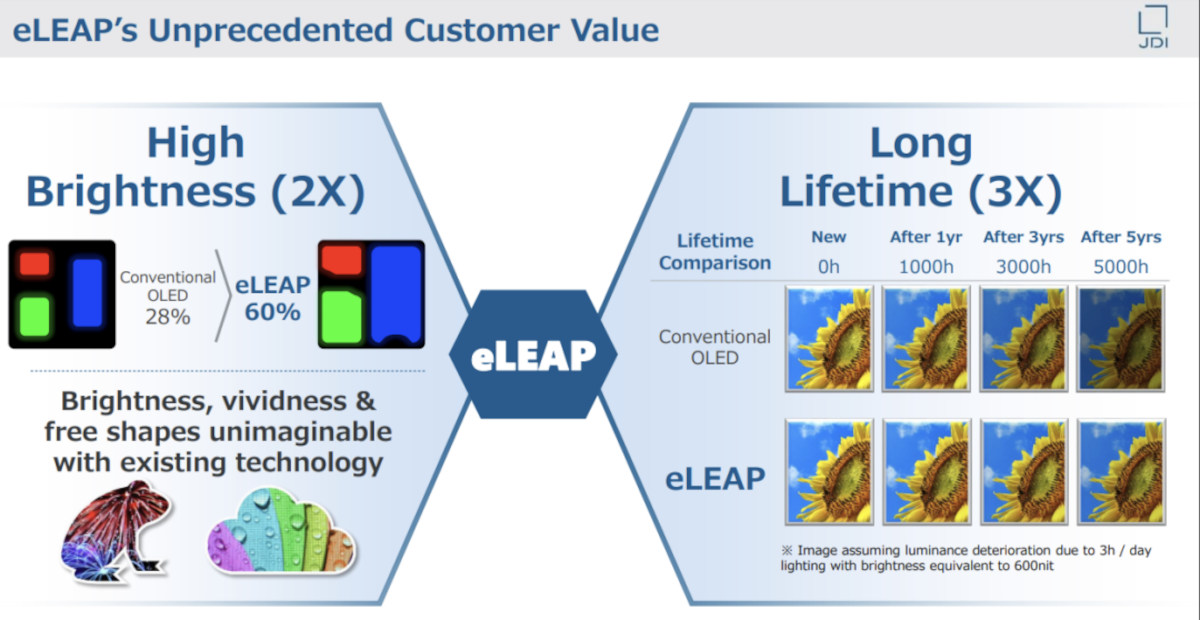
Last year, we reported that LG Display is looking into adopting Japan Display's eLEAP technology at its OLED TV production lines in Paju, perhaps seeking to produce RGB AMOLED displays for IT applications at these fabs that are currently under utilized. In April 2026, we reported that LG Display is progressing with this plan, and is checking an investment plan to apply eLEAP into its large-area OLED production lines, and earlier this month we reported that LG is accelerating its plans to convert some of its 8-Gen WOLED fab in Paju to eLEAP AMOLED production, and have already started to install deposition machines.

LG Display FLiPP logo

We now learn that LG will use the brand name "FLiPP" for its maskless OLED production process. The company filed for the trademark back in November 2025.

Read the full story Posted: Jul 29,2026

LG Display said to accelerate its plans to convert some of its 8-Gen WOLED fab in Paju to eLEAP AMOLED production

Last year, we reported that LG Display is looking into adopting Japan Display's eLEAP technology at its OLED TV production lines in Paju, perhaps seeking to produce RGB AMOLED displays for IT applications at these fabs that are currently under utilized. In April 2026, we reported that LG Display is progressing with this plan, and is checking an investment plan to apply eLEAP into its large-area OLED production lines.

JDI eLEAP aperture ratio image

Originally we heard that LGD plans to make a final decision on the eLEAP introduction by the end of 2026, hoping to secure Apple as a customer for these IT OLEDs. According to the latest report from China, LG Display has already ordered the required equipment - and even began installing some of the machine, that will enable it to convert its existing 8-Gen WOLED production line in Paju to eLEAP AMOLED production.

Read the full story Posted: Jul 13,2026

Samsung Display starts producing foldable OLEDs for Apple's first foldable iPhone

According to reports from Korea, Samsung Display has started to mass produce foldable OLED panels to Apple's first foldable iPhone. SDC is producing the foldable panels in its Asan, Korea hub, while the modules are produced in its Vietnam's module factory.

A render concept of a foldable Apple iPhone smartphone with a Samsung Display OLED

According to the reports, Apple's first order is for a total of 3 million displays that will ship in 2026. Samsung is the exclusive supplier of foldable panels to Apple, and Apple actually signed a 3-year exclusivity deal with SDC.

Read the full story Posted: Jun 24,2026

A spotlight on Visionox: a deep dive into the company's history, ViP and pTSF technologies, spin-outs, fabs and roadmaps

Visionox is one of China's pioneering AMOLED producers, and arguably the industry's most technically ambitious second-tier player. Grown out of an OLED research group at Tsinghua University, the company built mainland China's first PMOLED line, its first AMOLED pilot line, and its first dedicated Gen-5.5 AMOLED mass-production line, and it currently holds somewhere around 10% of the global smartphone AMOLED market. By the end of 2024 it had shipped more than 240 million OLED panels cumulatively.

Visionox logo

Yet Visionox is also the cautionary tale of the OLED industry. It is the smallest of the OLED focused panel makers, and the only major producer that remained loss-making in 2025, having accumulated roughly $1.2 billion in net losses over three and a half years. In late 2025 a Hefei government investment arm stepped in with a ~$410 million cash injection that made it the company's largest shareholder and de facto controller — a rescue that underlines both the strategic value Beijing places on a homegrown OLED champion and the financial fragility of the business itself.

That tension — between genuine technology leadership and a balance sheet under severe strain — runs through everything Visionox is doing right now, above all its $7.6 billion bet on an 8.6-Gen fab that will be the first in the world to attempt maskless OLED production at scale. In this article, we detail Visionox's history and corporate structure, its market position, its AMOLED capabilities and fabs, its ViP and pTSF technologies, its 8.6-Gen and microLED roadmaps, and its stock performance, opportunities and challenges.

Read the full story Posted: Jun 17,2026

O-Vision (Aoshi) Technology raises its Series-B funding round as it plans to scale up its photolithography-based OLED microdisplay production

Guangzhou O-vision (Aoshi) Technology has successfully concluded its Series-B funding round, raising over 100 million RMB (about $14.7 million USD). The company plans to use the funds mostly towards the construction of its 12-inch K2 OLED microdisplay fab.

O-Vision organic photolithographic patterning technology process image

O-Vision organic photolithographic patterning technology process

Aoshi has previously concluded its seed and Series-A funding round, which together raised over 150 million Yuan (over $22 million USD). 

Read the full story Posted: May 24,2026

Reinventing RGB OLEDoS: How Si2OLED Unlocks Power Efficiency, Brightness, color gamut, and Scalabilty [or: resolution]

Ths is a guest post by Ajit Krishnan, Director, New Business Development, Office of the CTO, Applied Materials, Max McDaniel, VP/CMO Display Business Unit, Applied Materials, Gunther Haas, CTO MICROOLED, and Thierry Bissuel, CEO MICROOLED. 

The pursuit of the ideal AR/VR microdisplay has become one of the most complex engineering challenges in our industry, with massive investments and the trajectory of spatial computing at stake. At its core lies a deceptively simple problem: how to produce red, green, and blue light from pixels 50 times smaller than a strand of human hair—without compromising efficiency, color accuracy, or the ability to manufacture at scale for mass adoption.

While many in the industry continue to wrestle with this challenge, evidence suggests that Si2OLED technology provides a compelling solution. To appreciate the significance of this approach, it is important to examine the prevailing methods in the market—and understand where they fall short.

Today’s leading commercial OLEDoS microdisplays largely rely on a white OLED combined with color filters (W-OLED + CF). In this setup, a white light source illuminates all pixels, and filters selectively pass red, green, or blue light to form images. This is the same architecture used in displays from companies like Sony, including those found in devices such as Apple Vision Pro. While functional, this design suffers from a fundamental limitation: color filters inherently waste light. Only about 25%  of the emitted light contributes to the final image, while the rest is absorbed. This inefficiency forces higher driving currents to achieve acceptable brightness, increasing power consumption, accelerating material degradation, and ultimately reducing device lifespan. In addition, in order to reach the required brightness levels, WOLED+CF architectures require the use of stacked, so-called tandem OLED devices which require a high operating voltage of around 12V which puts severe constraints on the CMOS backplane technology.

Read the full story Posted: Apr 30,2026