Burn in and Image Retention

Rtings.com finds that OLED TVs are actually more reliable than LCDs

Rrings.com posted a very interesting article, in which they detail the results of their ongoing TV longevity test, in which they test 102 TVs to see which one lasts the longest. The test has been going on for three years. In general - most TVs were fine for the first 10,000 of use, but 20 TVs died during the test and 24 suffered from some sort of damage.

The most interesting takeaway is that OLED TVs actually suffered from less failures than LCDs. Most people assume that the lower lifetime of the organic materials (compared to the in-organic LEDs and LCs used in LCDs) means that the TVs are less reliable. But OLED burn-in has been consistently shown to be mostly a non-issue for most consumers, and the LED backlighting has a much higher chance of failure.

Read the full story Posted: Dec 21,2025

The QD-OLED burn-in test continues, and results after 21 months and over 5,000 hours of use are very good

Three months ago we reported on an interesting OLED burn-in test performed by a YouTuber called Monitors Unboxed, on an MSI MPG 321URX QD-OLED monitor. After this long 4,500 hours (18 months) deliberate testing, the results were that there's a continual, gradual degradation, but not a drastic effect. This was very good results, considering the test style.

Monitors Unboxed is now back, and they share the results of the test, that is now in its 21 month, or over 5000 hours of use - see video above.

Read the full story Posted: Dec 05,2025

Someone tested a QD-OLED gaming monitor for 18 months, or 4,500 hours - and shares the burn in results

A YouTuber called Monitors Unboxed, launch an extensive OLED burn-in test 18 months ago, to check the MSI MPG 321URX QD-OLED monitor. After this long 4,500 hours deliberate testing, the results are shared in the video below.

First of all, it's important to note that these tests do not represent real gaming or work image patterns - showing only (or 95%, to be honest) static images is the worst-case scenario for OLED image retention. In any case, the YouTube says that after about 12 months, the monitor is just beginning to show some 'annoying' burn in. After 15 months - "there's been a noticeable increase in the visibility of the main artefacts in uniform dark grey test images," though only a small change.

Read the full story Posted: Sep 11,2025

DIVA Labs integrates OLED panels into real-time medical imaging

Medical display maker DIVA Laboratories, announced that it has successfully integrated OLED displays into ultrasound imaging systems, saying it overcame long-standing challenges with burn-in and panel lifespan.

The company did not detail the specification of its OLED displays. It does say that it overcame the lifetime and burn-in challenges by applying proprietary image control technologies—including Off RS, Orbit, and JB algorithms—to achieve greater stability and image consistency. DIVA says that it is now looking into adopting OLED displays in other medical domains.

Read the full story Posted: Jul 23,2025

LG to launch screensaver ads on OLED TVs, do owners need to worry about lifetime and burn-in?

LG Electronics is going to add screensaver ads to its TVs, including its high-end OLED TV range. It seemed the company has already started testing this new feature, which shows full-screen ads, and the company will offer a way to turn the ads off, as it markets the new ad system a "feature".

LG Ad Solutions company announced the new "Native Screensaver Ads" feature, that "capitalizes on idle screen time, turning what may be perceived as a period of downtime into a valuable engagement opportunity".

Read the full story Posted: Oct 02,2024

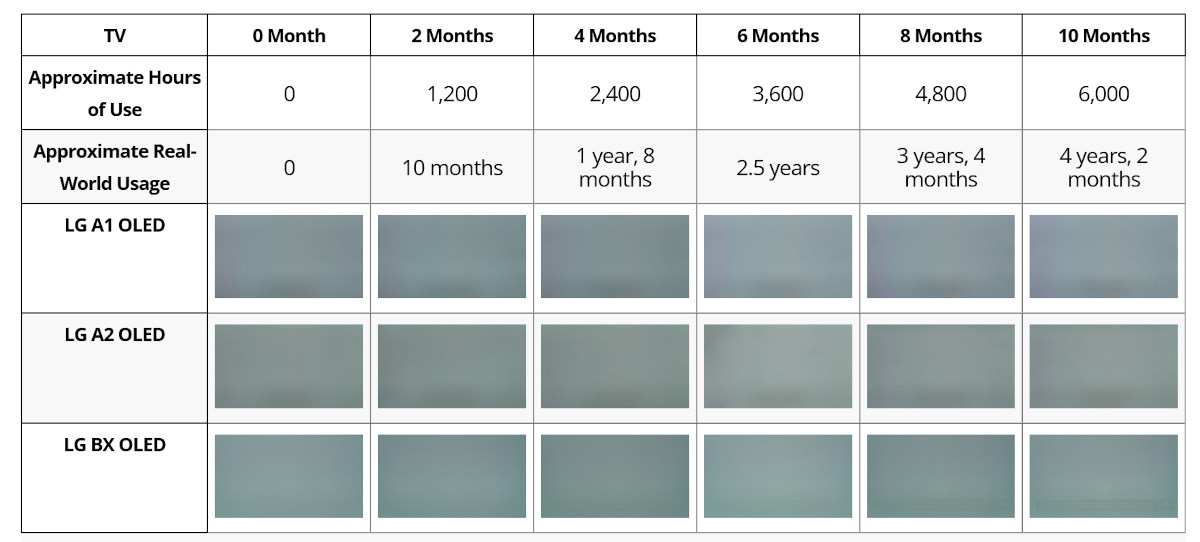
Rtings.com posts the results of its 10-month OLED and LCD display longevity tests

RTINGS.com posted an interesting article, detailing the results of their long-term (10-months) longevity tests on several OLED and LCD TVs and monitors. The test is simple - display a CNN feed constantly, and checking what happens. Note that CNN changed their logo a bit a few months into the test, but the team did not make any changes to the test itself.

As is expected, OLED monitors and TVs suffer from image retention problems, and the CNN logo is visible in some of these panels, when showing a gray screen. Some TVs suffer more than others. 

Read the full story Posted: Nov 25,2023

Rtings.com burn-in tests show Samsung's QD-OLEDs suffer from worse burn-in compared to LG's WOLEDs

Review web site Rtings.com has performed an extensive accelerated longevity test for over three months, testing the latest QD-OLED and WOLED TVs.y 

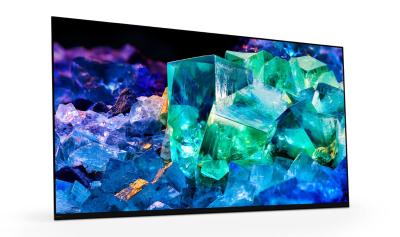
Sony A95K photo

Rtings reports that both QD-OLED displays (Samsung S95B OLED and the Sony A95K) showed signs of image retention, and it seems in general that the QD-OLED displays suffer from worse problems compared to LG's WOLED. Some of Sony's WOLED TVs also showed signs of image retention.

Read the full story Posted: Mar 18,2023

Japan Display announces a breakthrough lithographic-based OLED production method

Japan Display (JDI) announced that it has developed a new OLED deposition technology, which they refer to as eLEAP, that is cost effective and can be used to create OLEDs that are brighter, more efficient, and longer lasting compared to OLEDs produced using mask evaporation (FMM). eLEAP also enables OLED freeform deposition. JDI regards its new technology as a " historic breakthrough in display technology".

JDI eLEAP aperture ratio image

eLEAP is based on a lithographic method, and does not require any masks. The main advantage seems to be that OLED displays produced by eLEAP technology can achieve an aperture ratio of 60%, compared with FMM OLEDs which achieve a ratio of about 28%. This means that the OLED displays can be driven at lower currents - which extends the lifetime, improves the efficiency and also enables higher-peak brightness when needed.

Read the full story Posted: May 15,2022

The Nintendo Switch OLED display only shows signs of burn-in after an extreme 3,600 hours test

A YouTube technology reviewer Bon Wulff has performed a five-months long test of its Nintendo Switch OLED console, trying to estimate the burn-in problem in the device's AMOLED display. He used a static image, running it for hours, checking for any visible burn-in issues.

It turns out that it took 3,600 hours of nonstop projection of the single image for the AMOLED to exhibit any visible burn-in problems. This is an extreme test, which is a great testament to the durability of modern AMOLED displays, and a great reassurance to all the consumers who are worried about OLED display burn-in.

Read the full story Posted: Mar 08,2022 - 2 comments

Samsung Display starts developing a tandem OLED for Apple's iPad

Back in 2020 we reported that Apple is worried about lifetime and burn-in issues in AMOLED displays in tablet applications, and Apple decided to adopt a tandem OLED architecture in the displays it will eventually adopt in future iPad devices.

LG Display already developed such panels for automotive applications, and according to reports it is developing a tandem LTPO AMOLED display for Apple, aiming to supply these to Apple at around 2024. According to a new report, Samsung Display has launched a project to develop tandem OLED panels as it also hopes to supply panels for Apple's future iPads.

Read the full story Posted: Mar 03,2022