China slows down, Korea invests again: is the OLED industry's balance of power shifting?
For more than a decade, the story of the display industry has moved in one direction: China built, and Korea held. Chinese panel makers first overtook Korea in LCD, then spent heavily on 6-Gen flexible AMOLED lines, mostly financed by local governments and state-owned banks. China's share of global OLED capacity grew from only around 5% back in 2017 to over 40% in 2025 (this includes LG Display's Guangzhou fab). As recently as 2024, DSCC expected China to account for 85% of all display equipment spending between 2020 and 2027, with Korea at only 12%.
Korea, meanwhile, mostly consolidated. Samsung Display exited LCD and halted construction of its A7 fab in 2021. LG Display went through years of heavy losses, sold its last large-area LCD fab and held back from building an 8.6-Gen IT OLED line. As late as October 2025, Omdia warned that if Korea kept hesitating, China would hold 64% of the world's 8.6-Gen OLED capacity by 2028, and 70% by 2030.
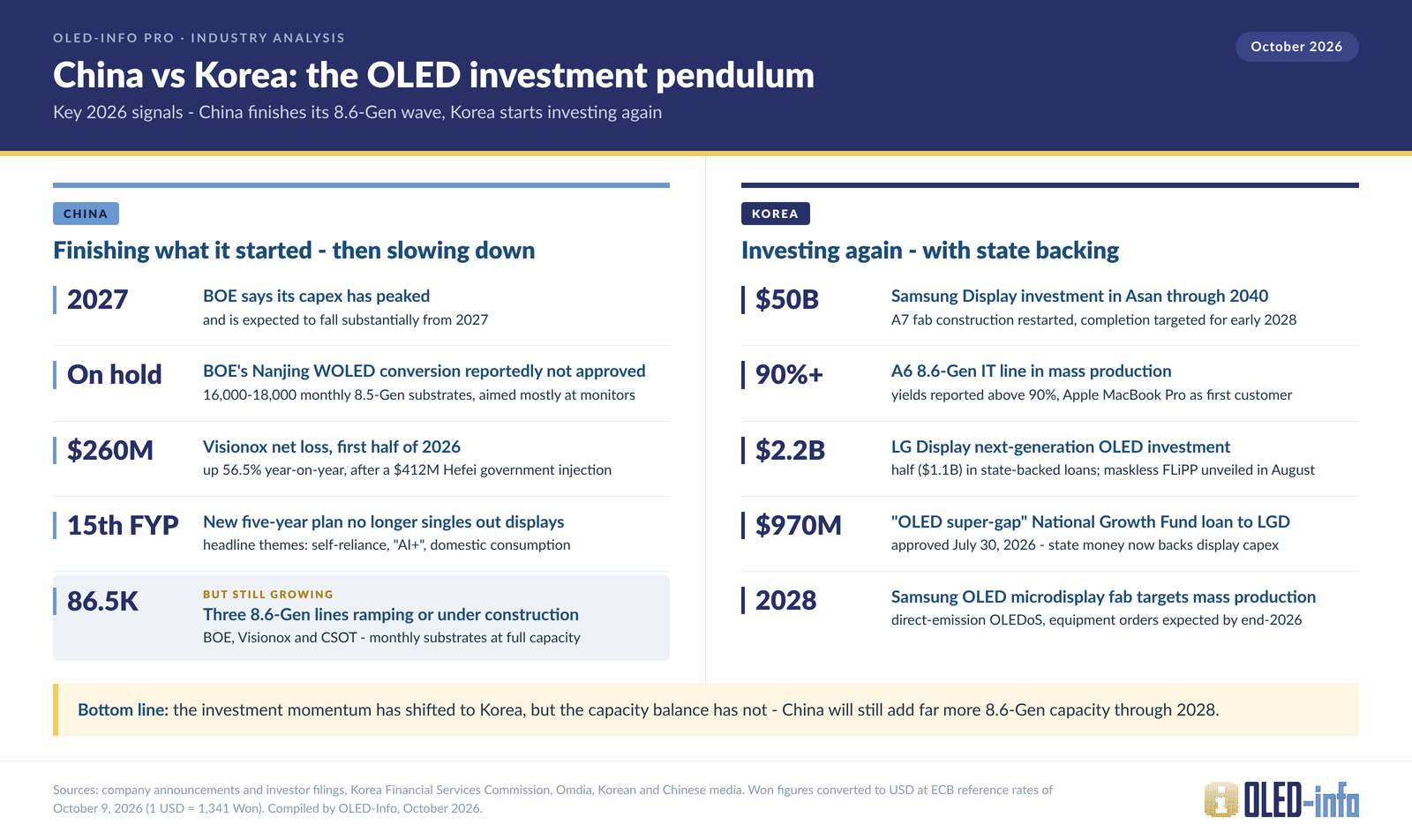
In 2026, the signals started to point the other way. At least one major Chinese OLED project failed to win approval, BOE says its capital spending has peaked, Chinese second-tier makers are losing more money, and China's new five-year plan no longer singles out displays the way earlier plans did. At the same time, both Korean makers announced their largest OLED investment commitments in years - with direct financial backing from the Korean government. In this article we look at what is actually changing and how much of it is real, and what it means for OLED monitors, automotive displays, maskless production and the industry's other geographies: Japan, Taiwan and India.