The COVID-19 pandemic created an increased demand for high quality IT solutions, including monitors and collaborative tools, which prompted OLED display makers to start offering solutions for this market for applications like computer monitors, signage and more.
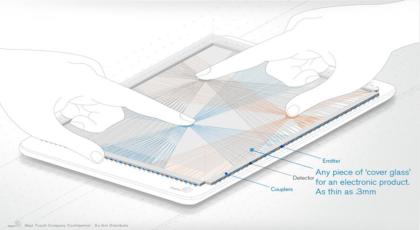
OLED displays that are 20-inch or more suffer from incompatibility with standard capacitive touch, because the thin OLED panel results in large parasitic capacitive coupling with the touch surface. The dynamic driving of OLEDs (where only lit pixels draw current) further reduces the capacitive touch performance by introducing unpredictable “display pattern noiseâ€. These issues are easily mitigated in small area displays, but as OLEDs increase in size, the performance and costs of capacitive solutions suffer.
Ireland-based RAPT has spent over 10 years developing a novel technology that overcomes these issues with large-area OLEDs. The company's frustrated total internal reflection (“FTIRâ€) technology is based on low-cost LEDs that create an optical mesh of infrared light signals, read by photodetectors. The LEDs and the photodetectors are placed on the edge of the OLED display. The performance is not affected by capacitive coupling or display pattern noise, and can be used on any screen size.
RAPT's solution offers superb optical and touch performance and is highly compatible with OLED displays. The technology is cost effective as it is based on off- the-shelf components and its costs grow linearly with size (unlike other touch solutions).
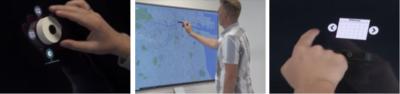
RAPT's touch solution offers unique advantages. It can support over 20 touch points in addition to active and passive pens, and can actively detect object shapes - which can open up unique UI possibilities - for example attaching a knob on the screen surface. RAPT's solution is suitable for curved surfaces and is immune to electromagnetic and electrostatic interference. Finally, a key aspect of FTIR is its 'through the waveguide' optics, which enables zero-bezel industrial design.
For more information on RAPT's touch solution, visit the the company's Website. RAPT is currently looking for partners and customers in the OLED industry to implement its next-generation touch technology in OLED panels. Contact the company here.
RAPT Touch was established in 2008, in Ireland. Based on its novel optical touch sensing technology, the company is offering multi-touch large-area display touch solutions. RAPT Touch is a privately held company, with over 90 issued patents. RAPT’s products have already been deployed in several projects and systems, including Google’s 55†Jamboard, and HiteVision products.