OLED is a new display technology, used to create thin, power efficient and bright displays. Today OLEDs are used in mobile phones, tablets, digital cameras and even TV sets - as OLEDs are considered the best display technology ever.
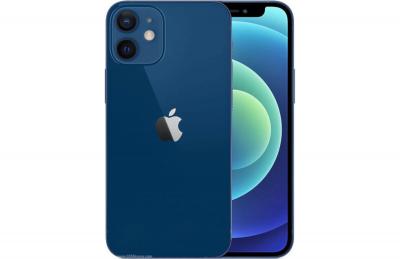
Apple's OLED iPhone
Apple's 10th anniversary iPhone X was the company's first OLED Phone - with a 5.8" 1125x2436 (458 PPI) flexible Super AMOLED display. Since then Apple has been adding more OLED iPhones, and as of 2021, the company's entire smartphone lineup adopts AMOLED displays.
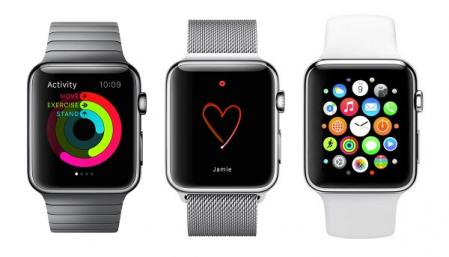
The OLED Apple Watch
In April 2015 Apple launched its first wearable device, the Apple Watch which used a flexible AMOLED display (made by LG Display). All Apple Watch products to date continue to use flexible AMOLED displays. OLED displays are especially suitable for wearable devices - as the displays are thinner and lighter than LCD displays, and are more power efficient (especially if you tweak the UI to suit the special OLED properties). According to reports, Apple is developing next-generation MicroLED display technologies for future wearable devices.
Apple OLED MacBook Pro
Apple's MacBook Pro range of high-end laptops started adopting an OLED Touch Bar instead of the traditional function keys in 2016. The display itself is either a 13" or a 15" LCD.
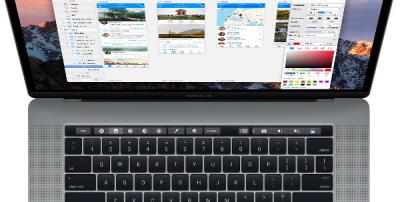
The OLED strip is supported by most of Apple's applications and can show commonly used emojis in messaging applications, bookmarks while you browse and other context-activated options. It also includes a Touch ID sensor that is activated for example when you wish to pay online (on supported web stores). Apple released an API to developers can support the Touch Bar in third-party applications.
The latest Apple OLED news:
LGD reports its financial results for Q2 2023, is on track in its 6-Gen line, but delays plans for an 8-Gen laptop OLED line
LG Display reported its financial results for Q2 2023, with revenues of 4.74 trillion Won ($3.7 billion USD) - up 7% from last quarter, and an operating loss of 881 billion Won ($690 million USD). LGD says that demand for display panels increased during the quarter.
LGD is on track to begin mass production of medium-sized panels in the first half of 2024, building a new 6-Gen production line, that is reportedly aimed to supply for Apple's iPad Pro, the first Apple tablet to sport an AMOLED display.


Samsung and LG are developing bezel-less smartphone OLED displays for Apple
According to a report from Korea, Apple approached both LG Display and Samsung Display, asking its suppliers to develop a completely bezel-less AMOLED display for future iPhones.

Designing an OLED without a bezel is a challenge, mostly because of the encapsulation layer that has to protect the OLEDs. Using an under-the-display camera is also said to be a problem for the OLED makers in such a design.
Omdia: the OLED market by area will grow to over 30 million sqm in 2030
Market research firm Omdia says that according to its latest forecast, the OLED market will grow at a CAGR of 11% from 2022 to 2030, by total display production area.
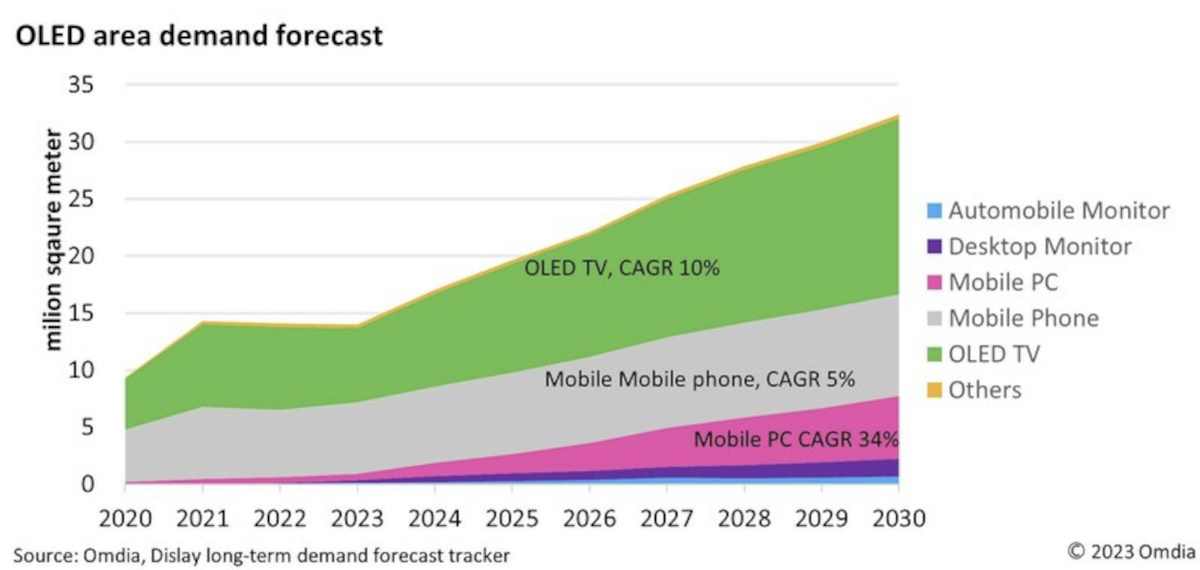
The main OLED application is smartphone displays, and Omdia says that in 2022 the penetration of OLED displays into that market reached 42%. The market share of OLED smartphones will rise steadily in the future. The OLED TV market is experiencing a slowdown, but Omdia says it will resume growth in 2024.
New laser repair system developed to fix AMOLED smartphone screen defects
An interesting video review shows a new repair system, based on lasers, that can fix defects in smartphone AMOLED displays. The system uses optical microscopy to find defects in operating OLED displays, and then a laser is used to fix the problems:
Such systems can be useful, but of course won't be able to fix all problems and defects in AMOLED displays, only ones that were caused by physical problems in conductive lines in the OLED module, that can be fixed by lasers. It will be interesting to see if these machines will truly find a place in the OLED repair aftermarket scene.
Noctiluca signs an OLED TADF emitter evaluation agreement with a leading consumer electronics company, likely to be Apple
Poland-based TADF OLED emitter developer Noctiluca announced that it has signed an Evaluation License Agreement with a leading consumer electronics maker, based in California. In fact, Noctiluca says that its partner is the world's largest consumer electronics company, that has several products that utilize OLED displays.
It's likely that Noctiluca's partner is Apple, that is interested in testing the company's emitters. According to Noctiluca, its partner will test the materials at its R&D facility and laboratory in Taiwan. This is likely to be an early stage testing agreement, but still a very interesting development.
Apple said to reduce its planned Vision Pro production volume as Sony cannot ship enough OLED microdisplays in 2024
Apple recently announced the Apple Vision Pro VR headset, with dual 4K OLED microdisplays produced by Sony. Sony's production capacity was known to be limited, and it was estimated that its entire capacity is around 900,000 units per year.
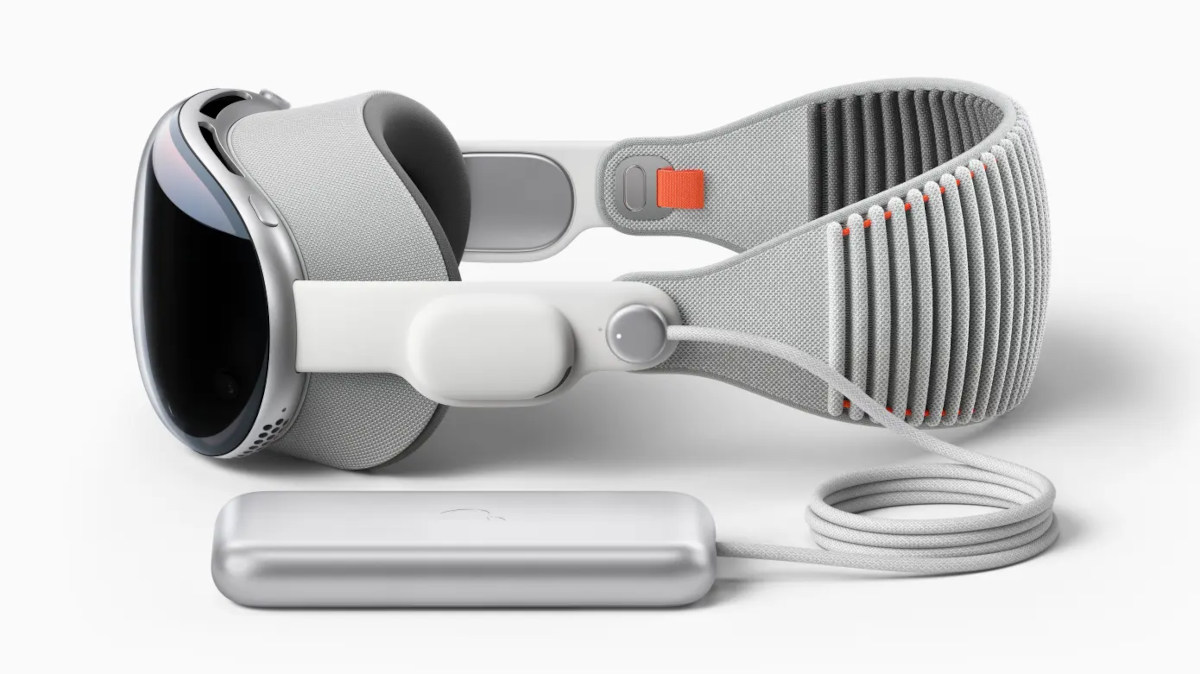
A new report by the Financial Times now suggests that Apple originally planned to produce around a million Vision Pro units in 2024, but it has scaled down its plan and now aims to produce only 150,000 units. The reports suggest that critical components are to blame, but it remains to be seen whether Apple will actually be able to sell a large number of these highly expensive devices.
DSCC: OLED panel revenues to decline in 2023, in a second consecutive year
DSCC says that OLED panel revenues will decline 7% in 2023 (to $38.9 billion), the second consecutive year that the OLED market is seeing a decline in sales. The largest declines will be in the OLED TVs and laptops segments.
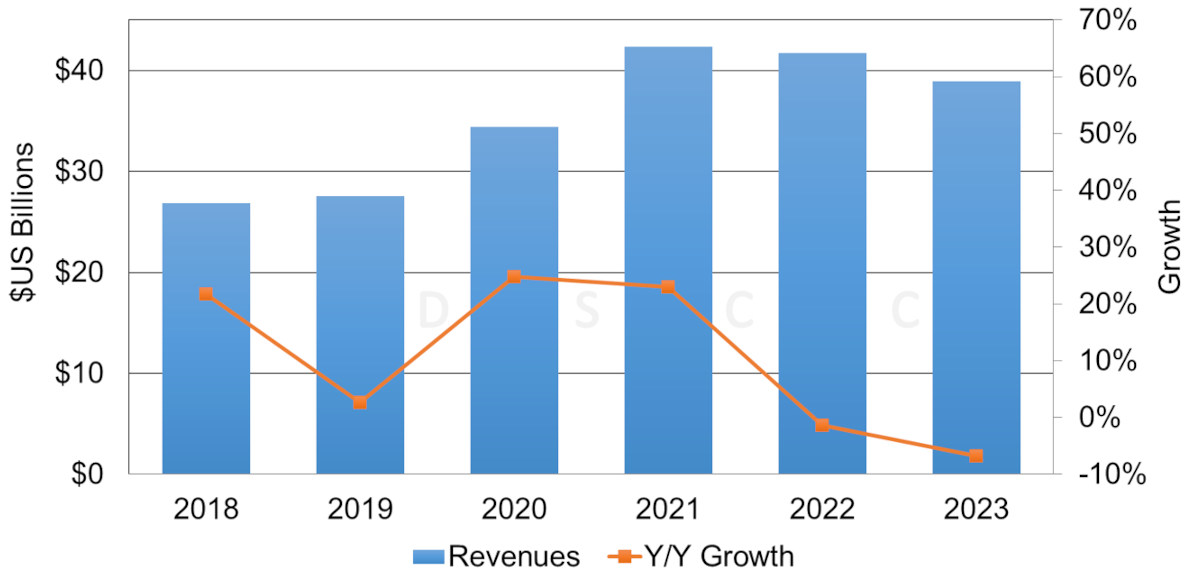
The OLED smartphone market will actually grow 4% in unit sales, but revenues will decline 5%. The OLED TV market will decline 29% in 2023 in both revenues and units. OLED laptop unit sales will decline by 15%. All other segments, including AR/VR, automotive and tablets, will grow in sales and revenues in 2023.
More details emerge on the OLEDs used in Apple's Vision Pro VR headset
Apple announced its first VR headset, the Apple Vision Pro, and new details are starting to emerge on the displays adopted by Apple. According to Business Korea, the external display (used to simulate the user's eyes) are OLED displays, produced by LG Display.
We do not know the exact display specifications yet. Business Korea says that these displays cost around $30 to make. They also say that the Sony 4K microdisplays cost around $350 each (which makes sense), and so together the OLED displays in Apple's headset cost over $700 - or almost half the total production cost (estimated at around $1,500).
BOE developed a 1.3" 4K OLED microdisplay, hopes to supply it to Apple's future VR HMDs
During DisplayWeek 2023, BOE demonstrated a new OLED microdisplay. The panel is 1.3" in size, and it offers a 3552x3840 resolution (4031 PPI), a refresh rate of 90Hz, and a color gamut of 90% DCI-P3.

This is BOE's largest and highest-resolution OLED microdisplay to date. BOE's current OLED microdisplays, already in production, include a 0.39", 0.49" and 0.71" FHD panels (all of which are available on the OLED marketplace, by the way).
Samsung Display starts ordering equipment for its 8.6-Gen IT OLED production line
According to report from Korea, Samsung Display has established a dedicated organization to head its new 8.6-Gen IT OLED Production line, and has started to order equipment. Samsung is converting an existing LCD line in Asan to OLED production, with an estimated cost of $3.1 billion.
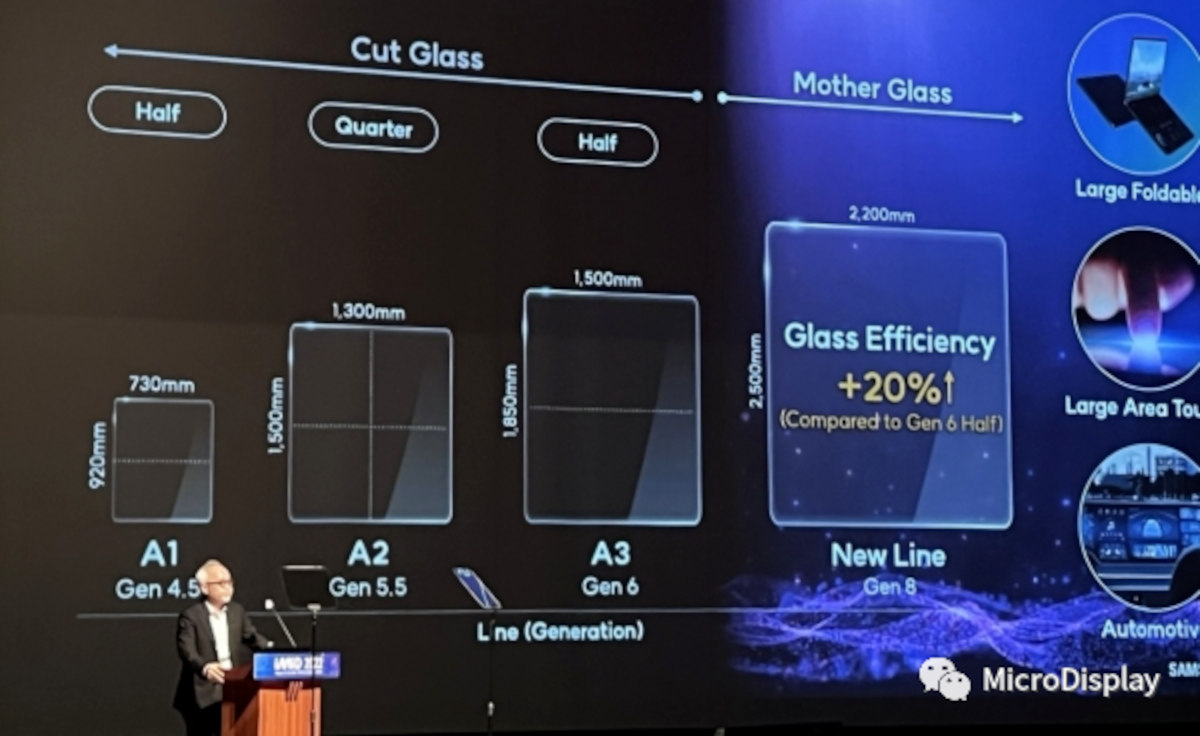
According to the report, SDC's decision to have a dedicated organization was made to give that team independence from the company's current small-area (smartphone/wearable) focused business and TV-focused business.