
OLED display producers

AUO Corporation

Taiwan's AUO Corporation (previously known as AU Optronics) was formed in 2001, by the merger of Acer Display and Unipac Optoelectronics. Later in 2006 AUO merged with Quanta Display. AUO is one of the world's largest producers of LCDs.

In 2006 AUO became the world's first AMOLED producer but in 2007 the company decided to shift focus back to LCD, and stopped investing in OLEDs.

BCDTEK

BCDTEK (also known as Shenzhen Xinshijia Semiconductor Technology) develops OLED ICs and OLED microdisplays.

IN 2022, BCDTEK announced it is building a $970 million 12-inch OLED microdisplay fab. In December 2023, it announced that the building construction is completed, for the first phase (the K2 fab).


BCDTEK is also constructing a $140 million OLED module line (the K3 fab) in Fengcheng, Jiangxi Province.

BOE Display

BOE Display, founded in 1993 in Beijing China, is one of the world's leading display maker, producing both LCDs and OLEDs. BOE also produces LCD backlighting units and solar panels.
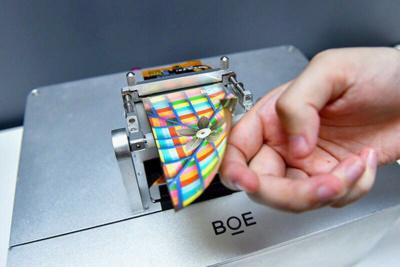


BOE has been producing small glass-based OLEDs for some time, but the company's focus is currently in flexible and foldable OLEDs. In October 2017 BOE started to produce flexible OLED displays at its first flexible OLED line, the Chengdu B7 6-Gen fab. The annual capacity of the B7 line, when complete and at 100% yields, will be 45,000 monthly 6-Gen substrates, or about 90 million smartphone OLEDs.


BOE Flexible AMOLED prototype photo

eMagin corporation

eMagin is engaged in the design, development, manufacturing and marketing of OLED microdisplays. eMagin's traditional markets are the defense and industry ones, but the company is also targeting the consumer VR and AR markets with its latest microdisplays. eMagin is a public company (NYSE AMERICAN:EMAN).

eMagin is developing high-end OLED microdisplays, and in early 2017 started shipping 2k x 2k displays. eMagin is also developing direct-emission OLED microdisplays. In 2023, eMagin was acquired by Samsung Display.

EverDisplay Optronics

EverDisplay Optronics (also known as Hehui Optoelectroics, and EDO), established in Shanghai, China in 2012, is an AMOLED display producer.

Everdisplay started mass producing AMOLED displays towards the end of 2014 in a 4.5-Gen line with a monthly capacity of 20,000 substrates (EDO was China's first AMOLED maker). Since then the company added its second production fab, a 6-Gen flexible AMOLED line in Shanghai.


EDO is producing panels for wearables, smartphones, laptops, VR devices and more. Many of EDO's displays are available in the OLED marketplace.

In 2021, Everdisplay became a public company.

Futaba

Futaba Corporation is a Japanese company that produces Vacuum Fluorescent Displays (VFDs) and other industrial and commercial components and modules. In October 2011 Futaba bought TDK's part in their PMOLED joint venture, TDK Micro Device Corporation, which is now a Futaba subsidiary.

Futaba develops and manufactures small PMOLED displays for consumer applications including flexible PMOLEDs. In 2022, the company signed a strategic agreement with RiTDisplay, that will produce PMOLED displays for Futaba, who is now likely not producing any displays in-house anymore.

HKC

HKC, established in 2001 in Shenzhen, China, is an LCD producer that has three LCD production sites in Chongqing, Chuzhou and Mianyang. The company is one of the world's largest LCD makers, with an estimated market share of around 10% from the global TV panel market, and around 6.5% of the global display industry as a whole.

HKC aims to become an AMOLED producer. In 2023, it started a collaboration with JDI to build an eLEAP AMOLED production line in China. These plans were canceled though towards the end of 2023. The company continued to develop its AMOLED technologies, and in early 2025 it acquired Royole's AMOLED production line equipment.

In July 2025 HKC produced its first AMOLED display sample - a smartphone type panel, produced on an advanced Oxide-TFT (IGZO) backplane.

Innolux

Innolux was established in 2009 in Taiwan as a merger between Innolux, CMO and TPO. Both TPO and CMO had OLED subsidiaries. The company was known as Chimei Innolux up until October 2012 when it decided to change its name back to Innolux.

CMO's OLED subsidiary was called Chi Mei EL Corporation (CMEL) and was producing AMOLED displays until the merger (the company was producing panels up to 7.6" in size). TPO was developing small (3-4 inch€) AMOLED displays but did not reach mass production and faced technical difficulties.

Japan Display

Japan Display (JDI) is a display producer, formed in 2011 in Japan by the merger of Sony's, Toshiba's and Hitachi's display businesses and funded by Japan's government fund Innovation Network Corporation (INCJ).

JDI was late to the OLED industry, and in 2017 JDI announced that it is going to perform a "last-chance" restructuring to focus on OLEDs as there is "no future for the smartphone panel business without OLED". The company however didn't achieve mass production of displays beyond small wearable AMOLEDs (which it supplied to Apple). In 2025, the company stopped its OLED production as it could not compete with larger scale producers.

In 2022, JDI announced a maskless OLED deposition process which they refer to as eLEAP. JDI is focused on that technology, but it has yet managed to initiate production. 

Kopin

US-based Kopin Corporation is a developer of microdisplays and other components for wearable devices.

In December 2016 Kopin announced it is developing OLED microdisplays, and the company since introduced several OLED microdisplays (the first ones were 1" 2Kx2K and 0.49" 1280x720) and announced several design wins.


Kopin signed agreements with OLiGHTEK and with BOE's JV with OLiGHTEK for the production of its OLED microdisplays, but later started working with Lakaeside Optoelectronics.

In early 2023 Kopin spun-off its OLED business unit to Lightning Silicon Technology.