Polarizer-free OLED

KDIA: Korean OLED market share has risen 1.5% in 2025, for the first time since 2015

The Korean Display Industry Association (KDIA) is quoting Omdia, saying that the OLED market share of Korean OLED panels (made by LGD and SDC) have increased 1.5% in 2025, to reach 68.7%. This is the first time since 2015 that Korea's OLED market share has increased. 

The KDIA lists several reasons as to why Korean companies managed to expand their OLED market share last year:

Read the full story Posted: Apr 29,2026

Reports suggest Apple and Samsung are developing a quad-edge-curved OLED for the iPhone 20

In 2027 Apple will release its 20th iPhone model, and it is reported that the company is working with Samsung to develop a special OLED display for the new device, which may be called the iPhone 20 - or the iPhone XX. 

A Quad-curved iPhone (AI render)

The new display is said to offer a polarizer-free (COE) architecture, a "micro-curved" flexible AMOLED that will curve on all four sides, and under-the OLED Face-ID and camera.

Read the full story Posted: Apr 25,2026

The end of the OLED process monoculture - what will it mean for supply chain companies?

For most of OLED's commercial history, the industry operated as a near-monolith: virtually every panel maker deposited RGB organic materials through a Fine Metal Mask (FMM) on 6th-generation glass (or polyimide substrates with a glass carrier), while LG Display stood as the sole practitioner of its WRGB architecture for large-area OLED production.

In recent years, we have seen the emergence of new OLED architectures, processes and materials that signal the end of this technological uniformity. In this article, we examine the different technologies, speculate how the industry is changing and where it is headed - and understand the implications for supply chain companies. 

Read the full story Posted: Apr 01,2026

TCL CSOT files a lawsuit against Samsung, Walmart and Best Buy, saying they infringe upon its OLED patents

TCL CSOT has filed a patent infringement suit against Samsung Electronics, Walmart, and Best Buy, saying that the companies are selling smartphones, laptops and wearable devices with AMOLED displays that infringe upon CSOT's patents.

CSOT includes three patents in the law suit. The first is US#12,133,429, that describes an OLED panel structure where the metal shielding under the TFT pixel circuits is connected to power lines via through-holes arranged so that the current always flows along the shortest, straight path between holes.

Read the full story Posted: Mar 21,2026

Omdia: polarizer-free OLED shipments to more than double in 2026, and continue to grow quickly until 2032

According to Omdia, polarizer-free OLED display shipments will more than double in 2026, to reach 72 million units (up from 31 million in 2025) - and continue to grow to reach almost 250 million units in 2032 (a CAGR of 22.7%).

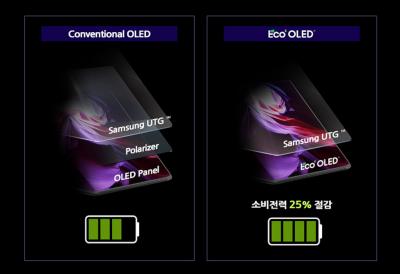
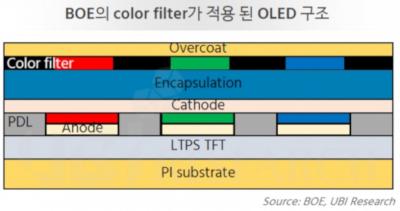
Omdia says that the removal of the polarizer layer, and replacing it with color filters on the encapsulation layer (Color Filter-on-Encapsulation, or COE), enables a meaningful increase in light emission, thinner structure, greater design flexibility, and improved color reproduction and privacy features. Some companies are using simpler technologies to replace the polarizer layer, like a simplified polarizer layer, that do not offer the high image quality of standard OLEDs or the increased efficiency of COE OLEDs, but are lower in cost. 

Read the full story Posted: Mar 11,2026

Samsung launches its 2026 flagship Galaxy S26 smartphone series, The S26 Ultra sports the first FMP privacy AMOLED display

Samsung announced its flagship 2026 Galaxy S26 smartphone family, with 3 models, all powered by LTPO AMOLED displays - and all will ship on March 11, 2026.

We start with the standard Galaxy S26, that features a 6.3" 1080x2340 120Hz 2060 nits (peak) LTPO AMOLED display, and either a Snapdragon 8 Elite Gen 5 or an Exynos 2600 CPU, 12 GB of RAM, and up to 512GB of storage.

Read the full story Posted: Feb 26,2026

TCL CSOT develops inkjet printing materials for polarizer-free OLED color filter deposition

TCL CSOT has developed a novel inkjet printing material for color filter deposition, that can be used in polarizer-free OLEDs that adopt a color-filter on encapsulation (COE) architecture. 

Samsung Display POL-LESS AMOLED structure image

Samsung's COE OLED structure (source: DSCC)

CSOT has already produced functional testing samples on 326 PPI OLED displays, meeting the industry's technical standard of a 30% power consumption reduction compared to polarizer OLEDs, and a reflectance of 6.41%. CSOT says that its IJP-COE process will simplify the manufacturing, increase material utilization and cuts costs.

Read the full story Posted: Feb 08,2026

Omdia forecasts fast growth for polarizer-free OLED panels

Omdia estimates that OLED makers will increase their adoption of polarizer-free OLED technology (sometimes referred to as Pol-Less OLEDs, and also as Color Filter on Encapsulation or COE, we will discuss this below), and the market share of the panels will grow dramatically in the future. 

According to Omdia, currently only about 0.1% of smartphone AMOLED panels utilize a polarizer-free architecture, but this will grow to 20.3% by 2032. In tablets, the market share is currently 0%, and it will grow tot 20.3%.

Read the full story Posted: Nov 01,2025

Samsung and Huawei launch a new range of OLED tablets, smartphones and a new tri-foldable phone

Both Samsung and Huawei launched a range of new AMOLED devices today. We'll start with the Huawei's Mate XTs Ultimate which is a tri-folding smartphone (the company's and the world's second) that offers a 10.2" 90Hz 2232x3184 COE LTPO AMOLED display (produced by BOE). 

Huawei also announced the MatePad Mini, a small tablet that offers a 8.8" 120Hz 1,800 nits (peak) 1600x2560 AMOLED display.

Read the full story Posted: Sep 04,2025