Spotlight on Universal Display Corporation, with investor bull and bear cases
Universal Display Corporation, or UDC, is one of the OLED industry's pioneers, and the company that probably represents the best success of any startup within the industry. UDC is worth $7 billion, and it has been historically the go-to company for anyone that wants to invest in the OLED industry.
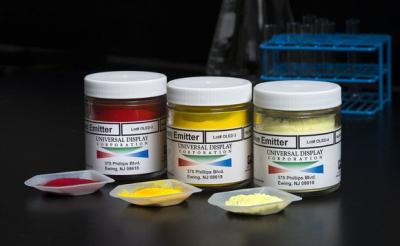
In this article, we detail the company's history, products and technologies, explain what PHOLEDs are all about, and also look into its future, and discuss both bull and bear cases as a investment opportunity. Disclosure: the author of this post holds shares in Universal Display.
The history of Universal Display Corporation
The history of Universal Display starts at 1994, when the company was founded by Sherwin Seligsohn in Ewing, New Jersey. The company was established to commercialize OLED technologies developed at Princeton University and the University of Southern California. UDC holds the basic patents of phosphorescent OLED (branded as PHOLED by UDC) technology.


UDC's OVJP subsidiary to invest $39 million over the next 5 years in R&D across a wide range of applications
UDC announce the recipient of the first Seligsohn award, in the field of organic neuromorphic electronics
Last year Universal Display Corporation announced the establishment of the Sherwin I. Seligsohn Innovation Award in honor of UDC’s late founder. Through this award competition, UDC seeks to support and celebrate organic electronics innovation. The award amount is $75,000 and is open to individuals and teams from around the world, and is also open for both academic and non-academic groups that are pushing organic electronics innovation in new and exciting ways.
UDC now announced that the first award was presented to Dr. Paschalis Gkoupidenis of North Carolina State University and the Max Planck Institute for Polymer Research for his research in Organic Neuromorphic Electronics to Empower New Forms of Physical Intelligence. UDC says that Dr. Gkoupidenis' remarkable work—using organic materials to emulate the human brain’s ability to sense, learn and adapt—exemplifies the kind of forward-thinking innovation that would have captivated Sherwin’s imagination.
Counterpoint: the global OLED material market to grow 7% in 2025, with China's share of the market growing
According to DSCC (Counterpoint), the global OLED evaporation materials market will grow around 7% in 2025. The market will continue to grow, and reach $28 billion by 2029, a CAGR of 7% from 2024 to 2029.
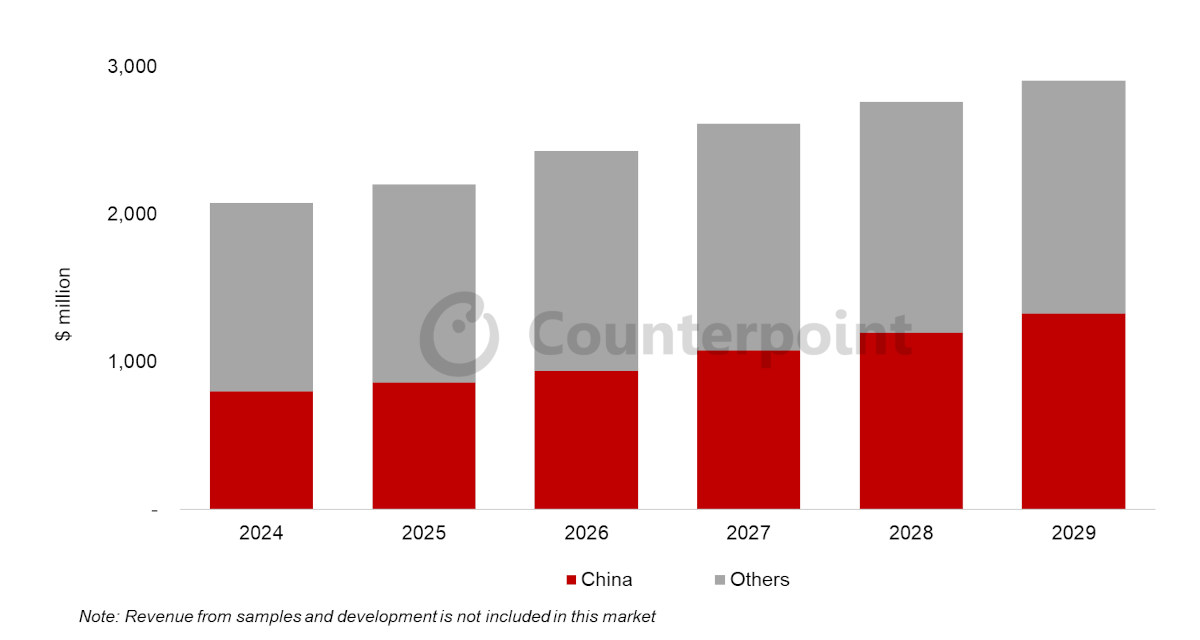
The OLED materials market is driven by the OLED panel industry, and it is expected that this market will grow driven by rising OLED adoption in IT devices (mostly laptops and tablets) and also driven by increased AMOLED production in China. The increase in adoption of tandem (multi-stack) based OLEDs also increase demand for OLED materials, as more material is required in such devices.
Universal Display reports its financial results for Q2 2025
Universal Display Corporation reported its financial results for the second quarter of 2025, with revenues of $171.8 million (up 8.4% from $158.5 million in Q2 2024). Its net income in the quarter was $67.3 million, up from $52.3 million in Q2 2024.
 The company says it had a strong quarter, and it is forecasting strong demand for OLED displays, mostly driven by higher demand for IT OLED panels and automotive OLED panels. UDC updated its full-year 2025 guidance, increasing the lower end of its revenue projection which now in a range of $650-700 million.
5 Pivotal Moments in OLED History, and thoughts about the future of OLED
OLED technology has transformed the display industry, enabling thinner, lighter, efficient and flexible displays, with superb image quality than ever before. The journey from laboratory discovery to mass-market dominance is marked by a series of pivotal moments. Here, we explore five of the most significant milestones that shaped the OLED landscape, followed by a look at other critical achievements and what the future may hold for the OLED industry and market.
1. The original Kodak OLED moment (1987)
The story of OLED began in 1987 at Eastman Kodak, where Ching Tang and Steven Van Slyke built the first operational OLED device. Their breakthrough combined modern thin-film deposition techniques with suitable organic materials to create a double-layer OLED that could emit light efficiently at low voltages. This foundational work proved that organic materials could be used to make practical light-emitting devices and laid the groundwork for decades of innovation. Kodak continued to develop OLED technologies, until it sold its entire OLED IP to LG for $100 million in 2009.
2. The invention of PHOLEDs and the founding of Universal Display Corporation (UDC, 1994-1998)
While early OLEDs used fluorescent emitters, the next major leap was the development of phosphorescent OLEDs (PHOLEDs). PHOLEDs, pioneered by researchers at Princeton University and the University of Southern California (and commercialized by Universal Display Corporation, founded in 1994), dramatically improved efficiency by allowing nearly 100% internal quantum efficiency, compared to about 25% for fluorescent OLEDs. This efficiency gain was crucial for battery-powered devices and large-area displays.
Blue Polariton-enhanced Purcell phosphorescent OLED emitters boost the lifetime 250 times, may finally unlock blue PHOLEDs
A team of researchers led by Prof. Forrest at the University of Michigan designed a new highly promising blue phosphorescent OLED emitter. The researchers demonstrated a tandem device that is based on these new emitters, that increased the lifetime 250 times compared to a conventional single-stack PHOLED device. This new design provide a real path towards a commercial blue PHOLED device.
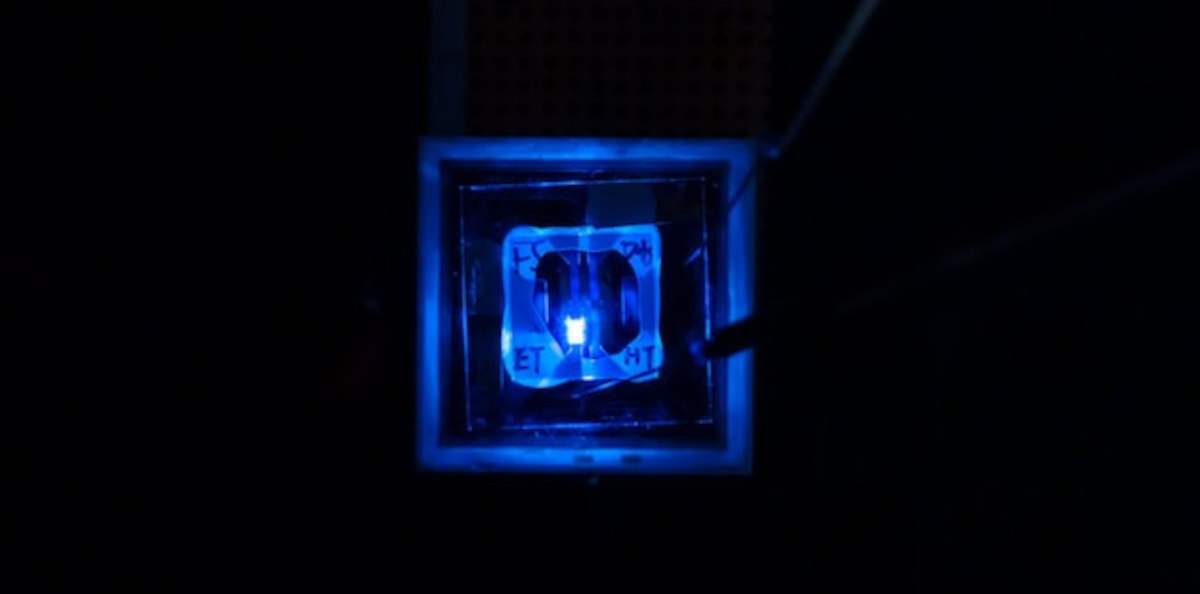
To achieve that dramatic increase in lifetime, the researchers applied a polariton-enhanced Purcell (PEP) cathode and anode, to create a so-called PEP-PHOLED device. The blue color coordinate is CIExy = (0.14, 0.12). The researcher say that this double-sided PEP effect can be integrated with other established lifetime-extending technologies.

