According to IHS, flexible AMOLED shipments reached 157.6 million units in 2018 - about 38.9% of the total AMOLED market (rigid + flexible). Flexible OLEDs will grow at a much faster rate than rigid OLEDs, and shipments will exceed those of rigid OLEDs by 2020 (335.7 million units). In 2022 over 400 million flexible AMOLED panels will be produced, compared to around 340 million rigid AMOLEDs.
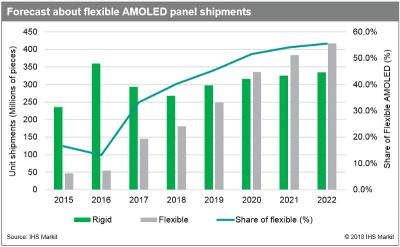
IHS sees demand for flexible OLEDs by smartphone brands that want to diffrentite their products using curved displays and full-screen ones. Foldable displays are also expected to be a key technology for mobile devices in the foreseeable future.
Comments
Maybe today it is impossible... but history tells us that LCDs are always very quick to close the gap with OLEDs on such issues. See this interesting post by DSCC, for example.


Hi,
In the report IHS wrote "...diffrentite their products using curved displays and full-screen ones." as I understand, is it impossible to make full-screen (zero edge) smartphones without flexible OLEDs? Can someone explain why?
Best Regards,
KK