Login | Register  
4D Systems OLED advertisement

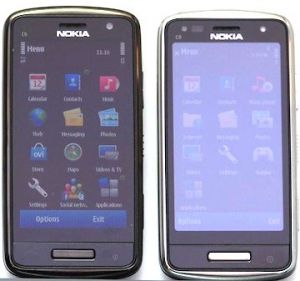
OLED in sunlight

The OLED-Association responds to DisplayMate's Nexus-One tests

A few days ago we posted about DisplayMate's Nexus-One display tests. Basically they are very unhappy with the OLED's performance, especially when compared to the iPhone's LCD.

Now Barry Young from the OLED-Association has sent us his response to these tests:

Last week, there was an incredible amount of Internet chatter, generated by one well-regarded tester (DisplayMate) and one blogger (DisplayBlog) comparing the AMOLED display in the Nexus I with the LTPS LCD in the iPhone.  In short, according to the tester, the AMOLED didn’t measure up. The evaluation was, to my knowledge, the first in-depth scientific comparison of the two displays. Did they help or just confuse the situation? There was a time when display architectures and the measurements of performance were relatively simple:

The Nexus One's OLED gets an in-depth technical check, turns out very bad

The DisplayBlog and DisplayMate are working on an interesting series of tests for Google's Nexus One phone AMOLED display and the iPhone's 3GS display. It's not finished yet, but they have posted the first tests of the AMOLED display. There's a lot of technical information, but here are the main conclusions:

  • The OLED is 800x480, but uses PenTile technology, that has two-thirds of the total number of sub-pixels found on an 800x480 LCD, so it won’t be quite as sharp as a typical 800x480 display.
  • The display has only 16-bits color depth, with just 32 or 64 intensity levels. DisplayMate say this is unacceptable for a high performance phone such as the Nexus One. The colors are coarse and inaccurate as a result. 
  • The display is excellent for text, icons and menu graphics, but poor for image and awful for resolution scaling. The problem with resolution scaling lies in the Android OS which uses a "laughably primitive scaling algorithm".
  • The peak white brightness is just 229 cd/m2 which is rather poor.
  • The black brightness is outstanding (0.0035 cd/m2) - so dark it is hard to measure or even detect.
  • The contrast ratio (65416) is great, the highest they have measured for a production display.
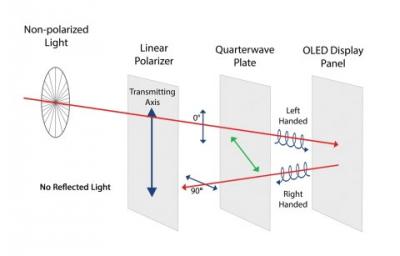
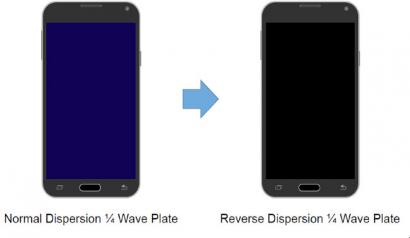
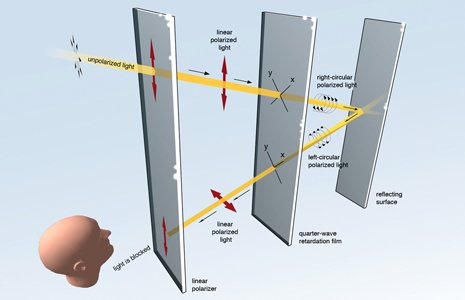
  • The screen reflectance is relatively high and washes out the image, makes it hard to view in bright conditions. 
  • The phone uses Dynamic Color and Dynamic Contrast which results is exaggerated colors and stretching of images.

Samsung's Super-AMOLED Wave phone outdoors video

We've got the first video showing how the new Samsung Wave phone (with the Super-AMOLED display) behaves outdoors. It seems that the visibility is great... We're still waiting for a video that shows it besides another phone outside so that we can get a good comparison.

Talking about the Wave phone, here's a nice video of it alongside an iPhone. The viewing angle is vastly better...

Samsung officially releases the s8500 Wave Super-AMOLED phone

Samsung has officially announced the s8500 Wave phone: with a 3.3" super AMOLED display and running the new Bada OS. The phone also has bluetooth 3.0 (another world's first). Interestingly, a few weeks ago we reported that Samsung are planning a Bluetooth 3.0 phone, which will have 'anti-reflective' and suitable for outdoor use'. So now we know that they have described the Super-AMOLED display.  

Samsung Wave s8500Samsung Wave s8500

The Wave other features: 5Mp camera, Wi-Fi, 1Ghz processor, a-GPS, accelerometer, 2GB/8GB of internal memory, micro-SD slot DivX/XviD support and 720p recording/encoding. It should be released worldwide around April. Via Engadget, who got to play with this phone and call the display 'gorgeous'.

Samsung's new phone has an anti-reflective OLED display for outdoor use

Update: Samsung has offically launched this phone as the s-8500 Wave, with a 3.3" Super-AMOLED.

Samsung has a new phone, the GT-8500. It's the first phone that has Bluetooth 3.0. But that's not the most interesting bit - it has a 3.1" touch OLED that Samsung say is "anti-reflective" and thus suitable for outdoor use. It'll be interesting to see how it behaves in direct sun, and to hear what exactly makes it anti-reflective...

OLEDs has been said to have poor sunlight visibility, although newer OLEDs are reportedly better.

Via PhoneScoop

The Nexus One in sunlight is actually better than the Droid?

The old OLED-in-sunlight saga continues. After hearing that the Omnia II is better than the Nokia N900, we get an interesting comparison between Google's Nexus One (3.7" AMOLED) and Motorola's Droid (3.7" TFT LCD). It's a long (and shaky) video, but here's the summary:

  • The AMOLED is brighter than the Droid, and behaves better at Sunlight
  • In normal conditions, the Nexus one has much more vivid colors. When viewing photos or videos, the AMOLED has much better colors.
  • The reviewer complains that he 'sees individual pixels' on the AMOLED - and this does not happen on the LCD (I'm not sure what he means). He says that sometimes the LCD's image is more 'crisp'.
  • Overall the AMOLED is much better than the LCD.

Here's the full video:

Samsung's Omnia II vs Nokia's N900 in direct sunlight

UPDATE: This video has been removed from YouTube

Yesterday we posted a video comparing the Samsung Omnia II's OLED vs the Nokia N900's LCD (and the OLED is much better, of course). Now the same user has uploaded another video, showing how the displays behave in direct sunlight - and the OLED is much better. This is interesting, as usually people say that OLED are very bad in such conditions. A couple of months ago we posted a story on this - showing examples of OLEDs in sunlight that are completely non-readable. Barry Young from the OLED association told us that newer OLED displays will be much brighter - perhaps he was right.


RSS feed Follow us on twitter Read us on your Kindle Copyright 2004-2009 Metalgrass software | Privacy Policy