Pulse-Width Modulation, or PWM, is one of the ways display makers can use to adjust the display's brightness. PWM is considered to be an easy (or cost-effective) way to control the brightness, but it has serious drawbacks, such as flicker that may cause eye strain and headaches. In this article we'll discuss PWM and its effects on OLED displays.
PWM basics
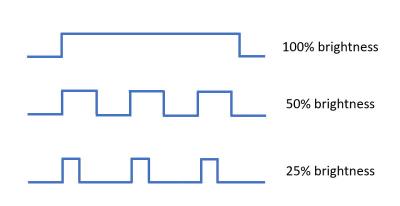
PWM is easiest to understand in displays that use backlight, like LCDs. In LCDs that use PWM, the backlight is always on at its fullest brightness. If you want to achieve a lower brightness, you turn the display on and off in a very high frequency. This frequency is not perceived by the human eye, which usually sees anything that flickers faster than about 60Hz (60 times per seconds) as consistent. Some people, however, are much more sensitive to flicker.
So if you want to achieve 50% brightness, you run your backlight in a 50% duty cycle (half of the time it is on, and half of the time it is off). This will be perceived as half as bright compared to a 100% duty cycle. PWM is easy to implement and it also can be highly efficient.
PWM drawbacks
As we said, PWM has serious drawbacks. PWM can lead to all sorts of discomforts, including headaches and even migraines after long-term exposure. Several studied claim that about 10% of people experience discomfort when viewing PWM displays (while the rest are either completely okay or with some very mild discomfort). Some people suffer very badly and the flickering may result in other health issues.
The alternative to PWM (which can be thought of as digital brightness control) is to control the brightness using analog means - by driving using lower voltage (or current, depends on the display), and keep the light emitting at a 100% duty cycle.
PWM and OLED
Now let's look at OLED displays. With an OLED, each sub-pixel is controlled individually and there is no backlight of course. An analog brightness control could be easy to implement - but with some OLED materials the emitted color changes with the voltage which makes this a bit more complicated to control.
According to our information, Samsung uses PWM (actually in combination with an analog brightness control) in all its mobile AMOLED displays. Consumers that suffer from flicker has tested and found PWM on many of Samsung's AMOLEDs. The following two images show camera-based of Samsung's Tab S 10.5 (left) and Samsung Galaxy J7 2017 (right). The Tab S flickers at about 264 Hz while the J7 flickers at around 225 Hz.

I tried testing for PWM on my LG 55" OLEDB6 OLED TV, taking a photo of a single white line (at 50% brightness) while moving my camera. This resulted in the photo you can see below, which seems to show that there's no PWM - although according to my information LGD (like SDC) is using a combination of PWM and analog control. This camera-based test can only detect low PWM rates and it may be that these OLEDs use a faster PWM that I could not detect. If anyone has more information on LGD's OLED TVs and PWM - please comment below.

Reducing flicker
I have discussed this with display-measurement expert Raymond Soneira from DisplayMate. Raymond confirms that he gets many e-mails from users of both LCD and OLED displays that sense flicker and suffer from visual fatigue and headaches. Some of this flicker, note, can be content related - as some streaming and video services may reduce the screen refresh rate or the frame rate below 60 Hz. Scrolling screen content also introduces additional flicker from the updating. For TVs, Intra-Frame Motion Interpolation can also produce picture flicker.
Below is advice that Raymond sends to readers, with flicker-related advice:
1. To minimize flicker effects do not watch the display in the dark, because the ambient light minimizes the flicker amplitude that reaches your eyes. Also avoid fluorescent and similar lighting that produces its own flicker that can beat with the display refresh rates.
2. Don't sit too close to the display, because it will fill a larger portion of your visual field, plus peripheral vision is more sensitive to flicker.
3. To minimize PWM flicker, operate the display at its maximum brightness because that provides the highest duty cycle. (editor: note that high brightness levels may harm your eyesight. It may be wise to use high display brightness in conjunction with brightness correspondingly decreased programmatically via graphics driver).
4. For TVs, monitors and laptops look for published screen refresh rates of 120 Hz or greater. For PCs set the highest available refresh rate.
5. People with very high flicker sensitivity may need to switch to LCD displays, which have relatively slow response times that will dampen any flicker. The LCDs should have full 24-bit color without Frame Rate Control (FRC) found in 18-bit (or less) displays. (editor: some users, however, complain of other issues with LCDs, for example crystal inversion that cause a half-RT flicker).
For more information, you can check out DisplayMate's Mobile and TV Shoot-Out main pages with articles that discuss some of these issues: Mobile Display Technology Shoot-Out article series and TV and Multimedia Display Technology Shoot-Out article series.
I would also like to thank OLED-Info's long-time reader Marat Tanalin for his help in this post.
Comments
Hi,
according to Rtings.com the LG Panels don´t use PWM.
best regards,
Rini
10% of the population suffering ill-health because of TV flicker is a stunningly large number of people. Globally this is billions of people. UK wide it is millions.Unfortunately everybody in our house suffers from it so I doubt that it is just 10%.Anyway, thanks for the article.
Unfortunately the article and the links give no help - where is the list of flicker-free TV's?So I am still looking for a PWM-free TV (and not one which blends PWM with something else instead of just properly getting rid of subliminal flicker).
You stated in your article “Some of this flicker, note, can be content related - as some streaming and video services may reduce the screen refresh rate or the frame rate below 60 Hz. Scrolling screen content also introduces additional flicker from the updating.”
what do you mean by this? I don’t think video service can control the display refresh rate unless you have a variable refresh rate display that adjusts to content being displayed. From what I know most tv content is 24fps aland has been that way forever. Even so if the display is sample and hold there shouldn’t be any flicker in between frames. Also what do you mean by scrolling content may introduce flicker? What is scrolling content and to what specific display does it introduce flicker to? Can you please explain?
Don't know about TV's, but for smartphones and laptops you can get good data here as to which ones have little or now PWM and which ones have a lot: https://www.notebookcheck.net/PWM-Ranking-Notebooks-Smartphones-and-Tablets-with-PWM.163979.0.html
But high brightness make it feel uneasy when we look away from the phone and it mostly feels way to bright to use. So should I use it at least brightness. Should I stop using phone at least brightness.
5. People with very high flicker sensitivity may need to switch to LCD displays, which have relatively slow response times that will dampen any flicker.
This sentence shows a gross misunderstanding of the nature of the problem from the author of the article. Slow response times of LCD displays are caused by the fact that the transparency of a subpixel is changed by physical reorientation of a liquid crystal in the filter. The PWM as a brightness control method, however, does not affect the LCD mask, it operates by switching the LED backlight on and off, which actually happens extremely fast (unlike in the older CCFL-backlit models), hence technologies like Lightboost or Turbo240 that use stroboscopic effect to achieve better motion clarity on LCD displays are even possible with LED backlit LCD.
I'm sorry to say I don't find any helpful information on notebookcheck. Com. It turns out that most of them say they're zero pwm when there is in fact pwm.
The pwm rates were not there, but the screen types were. I was wondering which of my devices were LCD, they all are. The device I have for work is LED, which answers a lot of questions for me. The highlighted model name just takes you to the review page.


As someone who lives in an OLED lit house I would want to know about any deleterious affects of a room lit by OLEDs at the half or quarter brightness setting. Of course it's a bit of an esoteric question that pertains to an audience of dozens or fewer.