Stretchable OLEDs

KAIST researchers develop an auxetic-based stretchable display platform

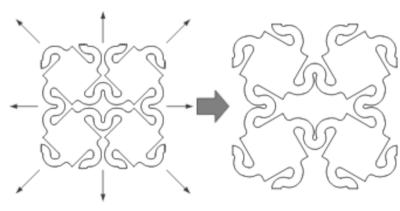
Researchers at KAIST developed an auxetic-based stretchable display platform, that expand in both width and length when pulled. Such a design could be used to enable a display that stretches in a uniform way at the same ratio in all directions.

The new design uses computational analysis to selectively connect only the necessary points that ensure isotropic expansion throughout the substrate, unlike standard methods that bond the auxetic structure and the stretchable substrate across the entire surface.

Read the full story Posted: Jul 09,2026

Samsung Display shows new display prototypes at SID Displayweek 2026, including its first PSF OLED panel

Samsung Display is showing its latest OLED displays, prototypes and technologies at SID Displayweek 2026.

First up we have Samsung's new Flex Chroma Pixel technology, that combines a PSF OLED emitter platform (this is the first time that Samsung Display shows a PSF OLED prototype), with a polarizer-free OLED architecture (Samsung LEAD) to enable high brightness and a wide color gamut: the new display achieves up to 3,000 nits brightness in HBM mode, while supporting the BT.2020-96 color space. 

Read the full story Posted: May 05,2026

Researchers from KAIST, US and China develop a high-performance liquid-metal based stretchable OLED electrode

Researchers from Korea's KAIST institute, in collaboration with colleagues from the University of Chicago and Suzhou University in China, have developed a new stretchable OLED electrode technology that enables higher performance under stretching conditions.

To enable this high performance (brightness) stretchable OLEDs, the researchers developed a hybrid liquid metal cathode. The electrode was deposited by stacking thin layers of liquid metal, and slight etching on the top layer. 

Read the full story Posted: Mar 04,2026

Researchers develop the world's most efficient fully-stretchable OLED device

Researchers from Seoul National University, in collaboration with researchers from Drexel University have developed the world's most efficient (17% EQE) fully-stretchable OLED device, using an exciplex-assisted phosphorescent layer and MXene-contact stretchable electrodes.

In a fully stretchable OLED, all constituent layers exhibit intrinsic mechanical stretchability. Most reported stretchable displays rely on rigid light-emitting devices connected by stretchable interconnects, and these suffer from poor mechanical reliability at junctions under strain, limited skin conformability, and degradation in display resolution.

Read the full story Posted: Jan 17,2026

Researchers develop new promising stretchable OLED ETL and cathode layers

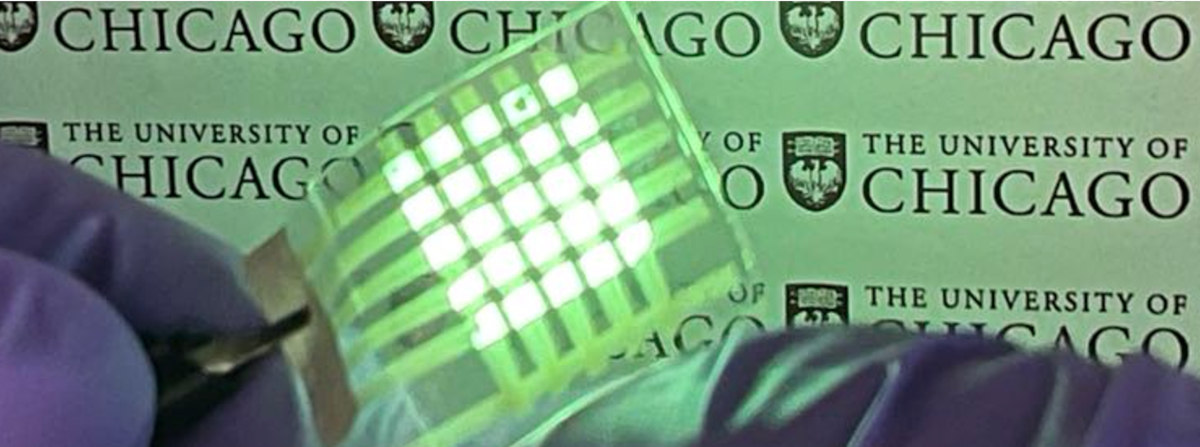
Researchers from the University of Chicago, lef by Prof. Sihong Wang, have designed a new OLED electron transport layer and a cathode, that are both highly stretchable and efficient.

To design the new ETL, the researchers designed a conductive polymer structure with high stretchability and ideal energy levels, achieving performance comparable with standard small-molecule electron transport layers.

Read the full story Posted: Nov 28,2025

Researchers suggest using overlapping pixels to create integrated stretchable OLED displays, we look into the latest stretchable display research and developments

Researchers from Korea's Advanced Institute of Science and Technology (KAIST) have designed a new integrated stretchable OLED display, that utilize overlapping qaudrant pixels in voids. The overlapped pixels are vertically aligned to optically function as a single pixel in the original state. Upon stretching, these pixels are spatially separated and become individually visible, thereby increasing the fill factor. 

The researchers have designed a reliable multilayered structure utilizing patterned adhesive and the deposition of patterned electrodes. They have deposited a passive-matrix (PMOLED) stretchable display, consisting of a 3 × 2 array with one central pixel and four quadrant pixels per unit. This display successfully displayed various letters clearly in both the original and stretched states.

Stretchable displays offer unique challenges, and researchers (and companies) are offering unique ways to enable the display to still display high quality images while stretched. In the past we have seen very interesting stretchable display demonstrations, research activities, in both OLED and microLED technologies, which we will detail below.

Read the full story Posted: Aug 23,2025

LG Display shows its latest OLED displays at SID Displayweek 2025

LG Display is demonstrating its latest OLED technologies, displays and prototypes at SID Displayweek 2025. The company is focused, this year, on three technologies: large sized WOLED panels, automotive displays, and next-generation technologies.

In the large-area WOLED zone, LG Display is showing its 4th-Gen WOLED panels, that adopt LG's tandem stack to reach a brightness of up to 4,000 nits. The new OLED panels also boost energy efficiency by approximately 20% compared to the previous generation (based on 65-inch panels), through enhancements in the element structure and power supply system. LG is also showing its latest 27-inch gaming WOLED panels, and its 45-inch 5K2K (5120x2160) monitor panel.

Read the full story Posted: May 14,2025

A new stretchable OLED design uses prestretched elastomer with optical adhesive film to achieve high efficiency and stability under strain

Researchers from Kyung Hee University in Korea have designed highly efficient stretchable OLED devices by incorporating the prestretched elastomer with optical adhesive film.

The researchers say that the so-called Geometrical Stretchable OLED (GSOLED) device enhances the efficiency of the OLEDs with the light extraction phenomenon brought by nanowavy corrugated structures. Furthermore, GSOLED shows stability in stretchable conditions and displays narrower emission spectrum with improved color purity.

Read the full story Posted: Sep 13,2024

Researchers from Korea develop high performance stretchable OLEDs based on rigid 3D islands and horseshoe connectors

Researchers from Korea's KAIST, in collaboration with Dong-a University and ETRI have developed a new stretchable OLED structure that is made from 3D rigid islands, or bumps. These so-called 3D-Pop islands remain unchanged as the display itself stretches and so maintain excellent performance.

The OLED islands are connected with parts that are curved in shape (similar to a horseshoe) that can be deformed while still operating normally, even at 500% tension. The whole structure can simultaneously utilize hinge-type rotation and tension of the bending connection connector, and is so not limited to a 2D plane. Even at 40% elasticity, the light emitting area remains at 85%. 

Read the full story Posted: Sep 11,2024

Researchers develop a promising seqeuntially-coated stretchable OLED device

Researchers from Korea's Yonsei University developed a new highly-promising stretchable OLED device by sequential coating technique. The new device can stretch up to 70% and maintain 80% brightness after 300 cycles at 40% strain. The OLED offers a maximum brightness of 3,151 nits and a total current efficiency of 5.4 cd/A.

The researchers say that standard stretchable OLEDs (what they refer to as intrinsically-stretchable OLEDs, or is-OLED) suffer from reduced performance due to orthogonal solvent problem and also the standard lamination process may cause defects and delamination. The new technique overcomes these issues.

Read the full story Posted: Jul 27,2024