Taiwan's National Tsing-Hua University is continuing its fight against the hazards of LEDs and white light - a research team from NTHU published a call to the public to think carefully about television, computer, phone, tablet and other LED-based display usage as the white light produced by LEDs can be hazardous.

The researchers say that people should consider new candle-light style lighting sources for reading, residence and street light. They also urge governments and legislators to enact new rules that will force light-based products to show the light spectrum emitted by the product.
The researchers quote an article published last year that suggests that white LED is linked to breast cancer. White light may case irreversible eye damage, it suppresses melatonin secretion at night and is linked to all sorts of health problems. The researchers are devoted to develop blue-hazard-free OLED, such as the orange OLEDs produced by WiseChip and installed in a Taiwanese village last year.
The researchers say that the orange OLED is much safer for residence illumination or for reading. They say that in some scenarios, typical 100 lx illumination can cause retina damage within 65 minutes. If you reduce the light to 50 lx, it will take two hours to cause the same damage. Using an incandescent light bulb that produces 50 lx, you will have to be exposed for 8 hours before suffering the same damage. An orange (candle) OLED that emits 50 lx will require 25 hours to create the same damage.
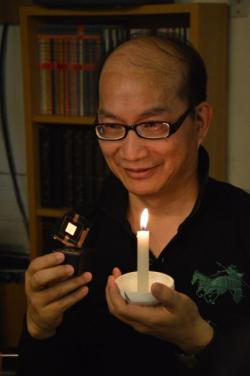
Wisechip already started to produce sample orange candle-light like panels. WiseChip's panels emit light in a vision friendly CT of 1,914K and a high CRI (93). WiseChip aims to start OLED lighting mass production in early 2015.


Of course it should also be mentioned that light this warm throws your body rhythm off if you are exposed to it during the day. For a healthy day/night cycle, it obviously takes lights that also have a decent amount of blue, while not spiking like white LEDs do and that have a temperature of 5500K (midday sun) to 6500K (cloudy day).