Flexible OLEDs: introduction and market status
OLED is an emerging display technology that enables beautiful and efficient displays and lighting panels. OLEDs are already being used in smartphones, laptops, wearables, tablets and TVs, and many of OLEDs are flexible ones.

A flexible OLED is based on a flexible substrate (usually polyimide). The first generation of OLEDs produced on these were not really flexible from the user perspective. The device maker bends the displays, or curves it - but the final user is not able to actually bend the device. These first-gen flexible OLEDs are adopted many premium smartphones, for example the Samsung edge-type Galaxy phones or Apple's latest iPhones. A plastic-based OLED has several advantages especially in mobile devices - the displays are lighter, thinner and more durable compared to glass based displays.
Second generation flexible OLED displays can be bent by the user - these can be used for example to create foldable smartphones - the first range of which started shipping in 2019 and today these are quite popular. Rollable OLEDs are likely to enter the market soon, offering the ability to create scrollable devices. In 2019, LG launched the world's first rollable OLED device - the 65" Signature OLED TV R but in 2024 it discontinued this device as its price was too high for consumers.

Where to buy flexible OLEDs?
While several companies (including Samsung, LG, BOE and others) are producing OLED displays, it is not straightforward to find a good and reliable supply of these displays.
If you are interested in buying a flexible OLED panel for your project or device, look no further. Our OLED Marketplace offers several flexible OLEDs, which can be ordered through us with ease.
Reports suggest Samsung is accelerating its rollable smartphone project, aiming to launch it in 2025
According to a report from Korea, Samsung is progressing with its rollable OLED development project, and the company aims to launch its first rollable smartphone in 2025. When fully opened, the phone will sport a very large 12.4" display. Interestingly, Samsung apparently will implement an under-the-display camera solution.
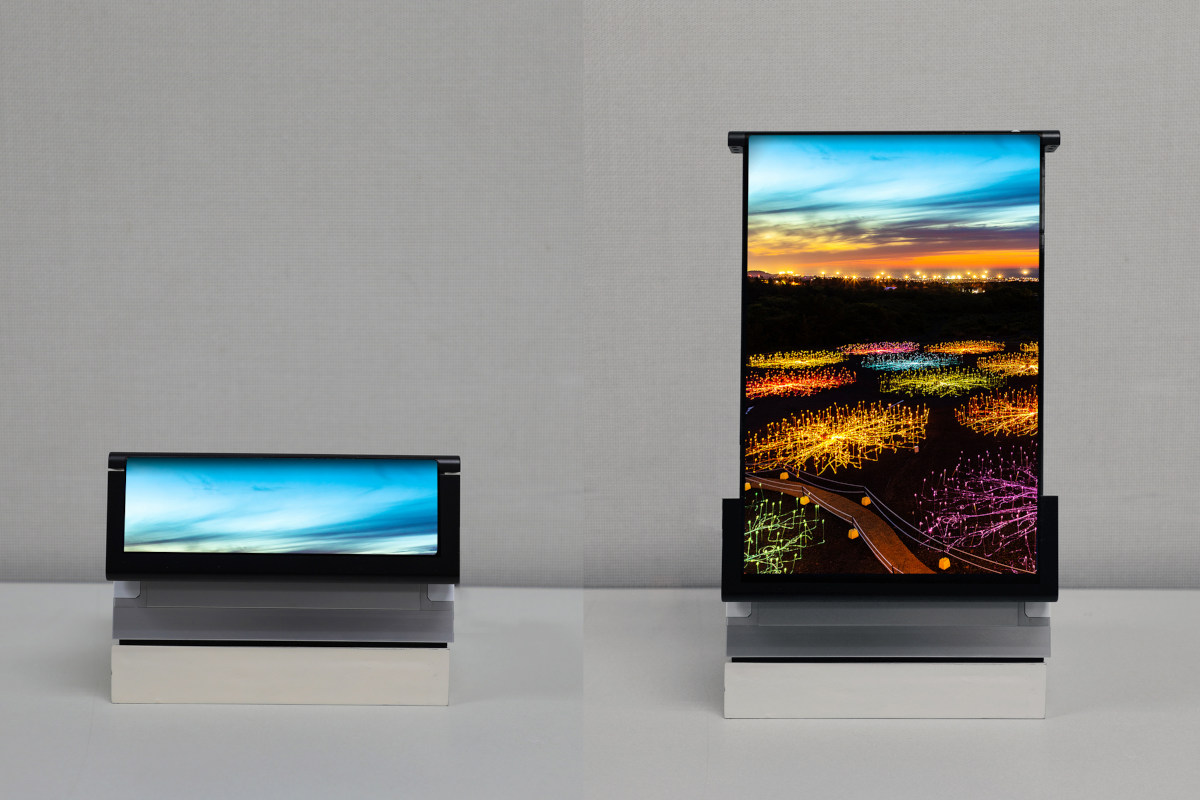
Samsung's acceleration of its rollable phone project is seen as the Korean device maker's response to Huawei's tri-folding smartphone, the Mate XT. It is seen that this was an embarrassment for Samsung, that recently also to witness LG Display's leading over it with tandem OLED production. It will remain to be seen whether Samsung's acceleration will lead to problems in quality and reliability - which happened when it launched the world's first foldable phone back in 2019.
Researchers from Korea develop high performance stretchable OLEDs based on rigid 3D islands and horseshoe connectors
Researchers from Korea's KAIST, in collaboration with Dong-a University and ETRI have developed a new stretchable OLED structure that is made from 3D rigid islands, or bumps. These so-called 3D-Pop islands remain unchanged as the display itself stretches and so maintain excellent performance.

The OLED islands are connected with parts that are curved in shape (similar to a horseshoe) that can be deformed while still operating normally, even at 500% tension. The whole structure can simultaneously utilize hinge-type rotation and tension of the bending connection connector, and is so not limited to a 2D plane. Even at 40% elasticity, the light emitting area remains at 85%.
Apple announces its 2024 iPhone 16 series, and the new Apple Watch Series 10, all with AMOLED displays
Yesterday Apple announced its 2024 iPhone 16 series, and its latest smartwatch devices - all based on OLED displays. We'll start with the the iPhone 16 that offers a 6.1" 2,000 nits (HBM) 1179x2556 Super Retina XDR LTPS AMOLED, while the iPhone 16 Plus offers a larger 6.7" 1290x2796 display. Both phones are based on Apple's latest 3nm A18 chipset offering improved performance and AI support.

The iPhone 16 Pro has a more advanced 6.3" 120Hz 2,000 nits (HBM) 1206x2622 LTPO Super Retina XDR OLED. The 16 Pro Max offers a larger 6.9" 1320x2868 AMOLED. These new phones are based on Apple's 3 nm A18 Pro chip, offer a "huge leap in battery life", support Apple Intelligence and feature new a main camera.
Huawei officially launches its Mate XT tri-folding OLED smartphone
Huawei officially announces the world's first tri-folding OLED smartphone, the Mate XT. The phone and its specifications will be unveiled on September 10, and will ship on September 20.

Huawei allows people to reserve their Mate XT phone, and already over 1.25 million people reserved it.
BOE progresses with the construction of its 8.6-Gen flexible AMOLED line in Chengdu
Towards the end of 2023, BOE officially announced its plans for a 8.6-Gen flexible LTPO AMOLED line in Chengdu. The agreement with Chengdu's local government was signed in early 2024, and in April BOE announced it is starting to construct the new fab.

Yeolight confirms it is the OLED lighting supplier for Voyah's Zhiyin
Last month China-based Voyah announced a new international all-electric SUV called the Zhiyin, that includes several innovative technologies. The taillights of the car are OLED lighting based, with 33 individually controlled OLED units on both the upper and lower sections, creating unique light patterns. We assumed that Yeolight is the OLED panel supplier, and indeed now the company confirmed that.

In addition to the OLED taillights, the Zhiyin will also an AMOLED display - a "curved sliding screen" that can "slide to accommodate different user needs". While this is not confirmed, we assume that this is a similar display to the one Hongqi just revealed yesterday - a sliding rollable 14.2" AMOLED panel produced by Visionox.
Hongqi launches the 2025 Guoya luxury sedan, with the first sliding automotive OLED display
China's Hongqi launched its latest luxury executive sedan, the Guoya (国雅), as part of the Hongqi Golden Sunflower series. The model was previously known as the HongqiL1.
The Hongqi Guoya adopts a 14.2" rollable (sliding) AMOLED display for the center multimedia display. This is the first time such an automotive sliding AMOLED display is produced commercially (and the only second rollable screen following LG's 2020 rollable 65" OLED TV which is now discontinued). The AMOLED display is produced by Visionox, and we know that it adopts an Ultra-Thin-Glass cover. Visionox says that the display weights less than 250 grams, and it has been tested for over 200,000 cycles.
BOE, Tianma, TCL CSoT, EDO and Visionox all post improved quarterly earnings
Recently, BOE, Tianma, TCL, EDO and Visionox all posted their financial results for Q2 2024, and all were rather positive. Samsung Display and LG Display also posted increased earnings for the quarter.
So we start with BOE, that posted revenues of 93.4 billion yuan (13.17 billion USD) for the first half of 2024, an increase of 16.47% over H1 2023. Its net profit increased 210% compared to last year (2.285 billion Yuan, or $320 million USD). BOE enjoyed increased LCD sales and optimized production, and also noted high demand for high-end foldable OLED displays.
Visionox completed the construction of its $1.6 billion 6-Gen flexible OLED module factory in Hefei
In 2022, we reported that Visionox announced plans to build a new $1.6 billion flexible 6-Gen OLED module production line in Hefei.

According to a new report from China,the company's construction partner, China Construction First Engineering Bureau, has finished the fab construction, that has passed the completion acceptance. It's not clear what is Visionox's timeline and plans to ramp up the fab and begin actual module assembly, but this is an important milesetone for Visionox's project.
Researchers develop an OLED-on-OTFT process to create high aperture wearable OLED devices
Researchers from China's Northeast Normal University developed a new integration strategy (called “discrete preparation-multilayer lamination”) that enables the deposition of OLED devices directly on top of OTFT transistors, to enable high-aperture wearable skin-patch OLED devices.

The new method starts with the preparation of the different layers on different substrates to avoid chemical and physical damage caused by process interferences, and then the transfer of the OLED devices onto the OTFT transistors. The researchers say that the resulting AMOLED display offers a high apreture ratio (83%), high mobility

