Login | Register  
4D Systems OLED advertisement

OLED ink-jet printing

Holst center extends its Roll-to-Roll line with a new sintering tool

The Holst Centre has released a new proprietary roll-to-roll (R2R) sintering platform for fast and low-temperature curing of printed conductive structures. The center is progressing towards a complete tool set for R2R manufacturing and can be used for plastic electronics such as flexible OLEDs, organic PV solar cells and more. Holst' line now includes printing, coating, drying and lamination stages in addition to the new sintering unit. A vacuum deposition stage is currently in development.

Screen printed structures on foil photoScreen printed structures on foil photo

High web speeds and low temperatures are key elements for R2R manufacturing of plastic electronics. The sintering platform uses a new photonic sintering process, developed by Holst Centre, which heats only the printed target material rather than the whole carrier substrate. The tool can sinter printed conductive structures in less than a second, which is already enabling a fast throughput speed of over 5 meters/minute. It also works at significantly lower temperatures than traditional sintering techniques, preventing distortion of the carrier substrates and reducing energy costs.

Kateeva plans to test a large-area OLED printer and inks in 2011

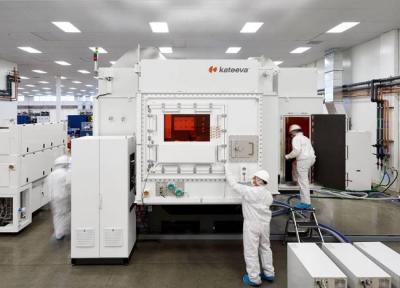
Kateeva logoBack in September we reported about Kateeva, a new startup that developed a method for printing OLEDs. Now we hear that the company is testing a prototype printer that can print displays sized 1.8x1.5 meters. Kateeva's CEO says that they are in talks with 'leading display makers' to test the printer and inks in 2011.

Via TechnologyReview

More information on Mitsubishi Chemical and Pioneer's OLED Lighting program

Mitsubishi logoPioneer LogoEarlier today we got word that Pioneer and Mitsubishi Chemical will jointly develop OLED Lighting. Now we have some more information. Pioneer will be the one to actually make the panels, and Mitsubishi will sell them across Verbatim's worldwide sales network. The plan is to start mass production in 2011, with a sales target of $335 million in 2015 and $1.1 billion in 2020. 

The two companies are currently researching OLED lighting panels that use printable hole injecting material (HIM) and new emitting materials, and  will also research printable OLED lighting development and commercialization. Mitsubishi plans to start early stage mass production and marketing of new printable emitting materials, which probably the PHOLED materials developed together with UDC.

We'll be able to view their first prototype (a dimmable/tone adjustable OLED panel, which Mitsubishi say it's the world's first) at the Light+Building exhibition, April 11-16 Frankfurt, Germany.

Via Twice

PETEC and the Flexible Display Center to collaborate on printed flexible displays

PETEC logoThe Flexible Display Center (FDC) at Arizona State University today announced that the UK's PETEC (Printable Electronics Technology Center) has become an Associate Member to collaborate on high-performing organic thin film transistors (OTFTs) for flexible display applications. OTFTs has potential in all sorts of display technologies such as e-paper and OLEDs.

The FDC is also working with UDC on flexible OLEDs. Earlier in 2009, they have already demonstrated a 4.1" monochrome QVGA PHOLED display.

PETEC was opened in March 2009. One of the companies that are building a production line is PolyPhotonix, who are working on OLED lighting.

Sony wants to launch flexible OLEDs "as soon as possible"

It seems that Sony are very serious about printed flexible OLEDs. In June 2009, they have created a group whose goal is to launch the flexible OLED panel business "as soon as possible". They had several researchers working on organic TFT in several departments in Sony, and now they all work in the same group.

Sony Flexible OLED Prototype (CES 2009)Sony Flexible OLED Prototype (CES 2009)

Sony wants to 'change the fundamental design of equipment" using the new flexible displays. They have already shown us flexible-OLED prototypes (photo abovce, and video below), and some cool concept designs. Hopefully we'll hear more at CES 2010 next week.

Via Tech-On's interesting printed electronics article.

Casio and Toppan Printing to co-develop OLED displays

Casio Computer wand Toppan Printing will form a new joint-venture to develop and produce OLED displays. The new JV, which will begin in February next year, will combine Casio's display production technology with Toppan Printing fabrication technology. 

Casio will set up the firm with around 600 employees (from ther OLED development team and LCD production unit), and will later sell a 80% stake in the firm to Toppan Printing.

Via American Chronicle

UPDATE: we now have a bit more information. The new company will focus on small and medium size displays. The new company will continue the development and sale of high-performance, high-quality products using Casio's Hyper Amorphous Silicon TFT (HAST) technology. So it will not be just OLEDs but also LCDs. Casio also wants the company to get an early start of sales centering on Casio's existing customers.

GE: roll-to-roll OLED Lighting panel printing is "real", reached over 90% yield

GE is working since 2003 on roll-to-roll OLED printing (of flexible and transparent OLED lighting panels). Dr Yan from GE says that in 2007, they had fairly high defects, around 65% yield. Today GE says hat their yield is between 90%-95%.

GE Flexibe, Transparent OLED lighting photo

One of the biggest issues GE is tackling is the flexible barrier layer to protect the OLED devices. GE has developed an "Ultra High Barrier" (UHB) by plasma enhanced chemical vapor deposition. The performance that has been achieved is low 10-5g/m2/day, with good transparency and adhesion.

Dr Yan says that roll-to-roll organic printing is real, and OLED lighting is getting closer. OLEDs are still around 15 times more expansive than conventional lighting, but the price will drop in time, and OLEDs will get cheaper than LEDs because of roll-to-roll printing and potentially cheaper materials.

IDTechEx believes that it will take between 5 to 10 years for OLEDs to become cost effective. But even before that OLEDs can be used in high-value products and niches.

Via IDTechEx


RSS feed Follow us on twitter Read us on your Kindle Copyright 2004-2009 Metalgrass software | Privacy Policy