
 In June 2008, I interviewed Corey Hewitt and Dr. James Buntaine from Kodak OLED Systems.
Mr. Corey Hewitt is the co-general manager, operations manager and VP of Kodak OLED Systems. Dr. James Buntaine is the second co-general manager, and also the CTO and VP.
They were kind enough to send us an update on Kodak's OLED program and market outlook:
Kodak OLED Technology Update & Advancements
Kodak expertise and experience lies in material discovery, organic layer design, mechanistic understanding, image science, panel/module design, and manufacturing technology. These key value drivers associated with the Kodak technology, know-how and patents, maintain Kodak as an industry leader in enabling both the OLED flat-panel display and OLED solid-state lighting industries. Provided below are selected key areas technology and Kodak accomplishments:
- Increase in efficiency:
- Low voltage materials (6.2V with 2-stack tandem)
- Novel dopants (50% year on year efficiency with long lifetime)
- Molecular modeling abilities with numerous OLED molecules per year being produced
- Property optimization:
- Intra-layer material formulation with chemical optimization of material combinations
- Fundamental optics modeling provides rapid design of organic stacks to meet new panel specs
- Inter-layer architecture design allows for simultaneous property optimization of spectral, power, lifetime, yielding 50% year on year improvements
Scientific knowledge:
- Degradation mechanism understanding drives new molecule design from fundamental science, saves years of empirical research
- Triplet exciton harvesting efficiency is closing the theoretical performance gaps
Image quality enhancement:
- Color-power mgt 25+% power reduction
- Automatic brightness limiting manages peak current requirements
- Tone scale optimization provides for ideal scene reproduction
- Pseudo resolution boost: e.g. QHD to HD using quad subpixels
Advanced design characteristics:
- Achieving world’s best light extraction with minimal thickness
- Pixel circuit design compensates for non-uniform, unstable TFT
- Printed chiplet panel design creates novel advanced designs for non-TFT AMOLED
- SSL design manages IR/luminance drop across a panel
Yield improvement:
Vapor Injection Source Technology (VIST): demonstrates material utilization of >70% and uniformity of previous interview)
- Ability to reduce TAC time from 8 minutes to 20 seconds
TFT yield improvement accomplished by Global Mura Compensation (GMC) with 30 sec calibration time. Kodak Advanced GMC will apply to medium / large TV applications. (You can read more about GMC in our previous interview)
- OLED yield improvement by use of Short reduction layer, decreasing dark pixel count by as much as 95%
Key hurdles for large-scale growth in OLED (display & lighting)
Kodak technologies address nearly all-critical performance parameters throughout the OLED value chain, which include:
Scalability: The ability to realize fully scalable large-size panels to Gen5+ scale will need Kodak’s proprietary White OLED technology (here's our previous interview with Kodak, focused on White OLEDs).
Lifetimes: Proprietary architecture allowing significant improvement in lifetime (Tandem OLED)
Manufacturing costs: Increased material utilization and reduced TAC (VIST); minimization of capital requirements (repurpose TFT facilities); expansion to flexible substrates (deposition techniques)
Yields: Ability to overcome TFT variations (GMC for display) and reduce defects (short-reduction layer)
It has become apparent that many companies have experienced, or are in the process of identifying these very difficult technical challenges in order to be profitable. Kodak discovered many of these challenges several years ago, and has continued to work diligently on these issues. Kodak is in a good position to provide know-how solutions to the OLED manufacturers of the future for both lighting and display.
Recent improvements in fluorescent devices:
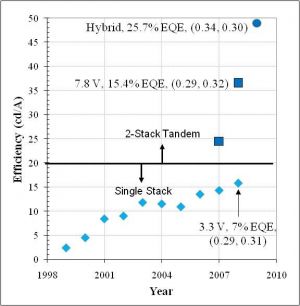
Green: 8.5% E.Q.E., 31 cd/A, > 65,000 hours lifetime at 1,000 cd/m2
White tandem for display applications:
15.5% E.Q.E., 36.5 cd/A, CIEx,y = 0.28, 0.33, 50,000 hours lifetime at 1,000 cd/m2
15.0% E.Q.E., 33.2 cd/A, CIEx,y = 0.28, 0.31, 87,000 hours lifetime at 1,000 cd/m2
- White single stack for display applications: 7% E.Q.E., 15.8 cd/A, CIEx,y = 0.31, 0.33, 25,000 hours lifetime at 1,000 cd/m2
Recent improvements in hybrid white fluorescent/phosphorescent systems:
Hybrid white fluorescent/phosphorescent systems for display applications have achieved 25.7% E.Q.E., 49 cd/A at CIE x,y = 0.34, 0.30 and 40,000 hours lifetime at 1,000 cd/m2.
OLED for white-light
Kodak has succeeded in demonstrating an OLED device architecture having an efficacy over 66 lm/W. This remarkable, world-leading efficacy exceeds the target of the DOE Energy Star Program for SSL while maintaining a color and CRI that meet specifications. The architecture is based on small molecule OLED and comprises four key technology components that enable this achievement: internal light extraction-enhancement structure, low voltage design, stacked architecture, and fluorescent-phosphorescent hybrid emitters. We are simultaneously improving the device lifetime and can see possibilities of T50 lifetime exceeding 50,000 hours operating at 1,000 cd/m2 luminance.
In addition to device performance, we are also working on many key technologies which we believe are critical to success of OLED lighting. We have begun building OLED prototypes incorporating these technology components; the 6 panels displayed at SID2009 are a good demonstration of our initial efforts. A few examples of Kodak technologies targeting critical manufacturing issues for OLED lighting are:
Kodak’s proprietary internal light extraction-enhancement structures more than double the out-coupling efficiency of white OLEDs;
Unique monolithic-integrated serial connection panel architecture enables the fabrication of large area lighting panels with low cost and minimal IR loss. This structure is also fault tolerant, reducing the impact of shorting defects;
Short-reduction layer reduces the density of shorting defects by orders of magnitude, which can greatly improve the manufacturing yield of OLED lighting panels;
Vapor Injection Source Technology (VIST) will drastically reduce the manufacturing cost of OLED lighting panels by increasing material utilization and reducing TAC time. We believe TAC times
Tandem OLED architecture that allows significant improvement in lifetime and enables a convenient method to balance the OLED emission to meet the Energy Star color requirements; and
In order for OLED lighting to successfully compete in the marketplace, manufacturing cost must be addressed. Kodak believes OLED lighting panels can be manufactured with acceptable margins if TAC times are
Another great feature of OLEDs is Chiplets
Kodak presented a joint paper with Semprius at SID 2009, detailing our work combining OLEDs with chiplet backplane technology. This technology is attractive, because it enables OLEDs to be manufactured without a TFT fab. The technology has the potential to revolutionize the industry, enabling new features (flex, sensors, …) and opening new markets for OLED. Chiplets would leverage the foundry model of the semiconductor industry, opening a path for OLEDs to have much lower cost than LCD. Kodak and Semprius have:
Demonstrated feasibility of AMOLED displays using transfer-printed integrated circuit backplanes;
The luminance, contrast, uniformity, and controllability of the resultant OLED displays were comparable to or better than the performance of commercially available LCD displays;
Demonstrated high yields with the transfer printing process.
 0.75-inch Chipmunk OLED Display (64x64)
SID 2009 and FPD 2009 Demonstrations
Kodak demonstrated several innovations for OLED displays at the SID’s Display Week 2009.
- High-Brightness RGB to RGBW Transform Technology:
- Double the luminance of your RGBW display with the push of a button
- No additional voltage required (same power supply and TFT design)
- No significant degradation of visual image quality
- Compensation Technology for Low-Cost, Large OLED Displays
- Prevents image-stick by compensating for the aging of OLED materials and a-Si TFT
- Compensation is performed with no impact to the viewer
- Developed in partnership with Ignis Innovation, Inc.
- Kodak Global Mura Compensation Technology (GMC) was featured in the Kodak AMOLED Wireless Picture Frame (a CNET Editor’s Hot Pick of CES 2009 and winner of a Photokina Star Award)
Kodak also demonstrated its world-class OLED lighting technology at SID2009.
- Recipient of Frost & Sullivan 2009 OLED Lighting Enabling Technology of the Year Award
- More than 65 lm/W efficacy, meeting DOE Energy Star specifications for color and color rendering index
- Long-life fluorescent and hybrid architectures
- Novel light extraction structures, short reduction layer, and fault-tolerant panel architecture that enables the fabrication of large area lighting panels with low cost and minimal heat loss
- Recognized by the Department of Energy for outstanding performance in the field of OLED solid state lighting and awarded a $1.7M contract
Please visit Kodak’s booth at FPD International in Yokohama, Japan October 28-30, 2009 for the latest innovations in OLED for display and lighting!
Industry Outlook
The worldwide recession resulted in slower capital investments, which have delayed the OLED industry market ramp.We believe several OLED manufacturers continue to prepare for large growth and scale for the future. It seems almost every day there are updates for new display products (near eye displays, phones, TVs, Laptops) coming to market. In addition, OLED lighting applications are making a lot of progress. Kodak remains very optimistic both markets will eventually reach their full potential and that Kodak’s technology and know-how will assist in the ramping process for creating low-cost, high-quality OLED applications and products of all sizes and applications.
You can find more details on Kodak's technology over at Kodak's web site.