Transparent OLEDs

CombOLED - A New EU Project For Cost Effective OLED Mass Production

OSRAM Opto Semiconductors is spearheading the effort to develop cost-effective volume production methods for organic light emitting diodes (OLEDs) under the CombOLED project, a European funded research and development project that was conceived to combine new device structures, advantageous manufacturing approaches and less complex materials with the aim to achieve cost effective OLED lighting solutions.

Interview with Mary Kilitziraki, Fast2Light project manager

In April 2008, we had the chance of interviewing Mary Kilitziraki, Fast2Light's project manager. Fast2Light is an integrated (9 companies, 3 research institutes and 2 universities) R&D project that aims to research and develop light emitting foils based on OLED tech.

Engineers Develop Transparent AMOLED display

Researchers at Purdue University have created the first active matrix display that uses a new class of transparent transistors and circuits. The researchers say this is a first step towards flexible color monitors and “heads-up displays” in car windshields.

New Transparent White OLED from OSRAM Opto Semiconductors Achieves High Level of Performance

OSRAM Opto Semiconductors has developed a transparent white OLED tile with outstanding performance. Under laboratory conditions, the OLED prototype has achieved a luminous efficiency of more than 20 lm/W at a brightness of 1000 cd/m². This opens up possible applications such as partitions that are almost invisible by day and can provide a pleasant diffused light at night.

The large-scale prototype of the transparent white OLED tile with color coordinates 0.396/0.404 (CIEx/y main emissive side) lights up an area of nearly 90 cm². The OLED is transparent whether it is powered on or off, and its transparency is currently rated at 55%. As the product is further developed, this value is expected to reach 75%.

UDC Announces Advances in Transparent White OLEDs for Lighting Applications

Mr. Sidney Rosenblatt, Universal Displays Chief Financial Officer, discussed and demonstrated the Companys new white lighting concept. Supported, in part, by the U.S. Department of Energy (DOE) under a Small Business Innovation Research (SBIR) grant, researchers at Universal Display recently developed a novel OLED lighting prototype that emits white light energy-efficiently when turned on and becomes transparent when turned off.

With a power efficiency of 45 lumens/Watt (lm/W) demonstrated to date and the possibility of achieving up to 150 lm/W with additional development in the future, white phosphorescent OLED lighting has the potential to lead to significant energy savings and additional environmental or green benefits. Additionally, the very thin and transparent form factor of this new lighting concept offers numerous design advantages that may enable a variety of novel uses as compared to existing incandescent and fluorescent lighting products.

Purdue and Northwest Universities: new flexible and transparent transistors

Researchers at Purdue University and Northwest University have developed a flexible and transparent transistor using a combination of zinc-oxide and indium-oxide nanowires. These invisible and bendable transistors actually preform better than conventional transistors, and can be easily built onto sheets of flexible plastic.

Unidym Signs a Collaboration Agreement with IMRE to Develop OLEDs Incorporating Unidym’s Transparent Electrodes

Arrowhead Research Corporation announced today that its majority-owned subsidiary, Unidym, has entered into a collaborative agreement with the Institute of Materials Research and Engineering (IMRE) in Singapore to develop organic light emitting diodes (OLEDs) incorporating transparent electrodes made of carbon nanotubes. Under the terms of the agreement, Unidym will provide IMRE researchers with access to its proprietary, carbon nanotube-based, transparent electrodes which IMRE will incorporate into its OLED devices.

Carbon nanotube-based transparent electrodes have the potential to improve the performance of OLEDs while also reducing their production costs.

German researchers claim first transparent OLED pixels

The researchers, located at the Technical University of Braunschweig, are claiming the development to be a world's first. Their approach is to use transparent TFTs (thin-film transistors) made of a 100-nanometer-thick layer of zinc-tin-oxide, which transmits more than 90 percent of visible light. Such transistors are more often made of silicon, which is used for LCDs (liquid crystal displays) but is highly absorptive in the visible part of the spectrum.
In the devices developed by the researchers, the brightness of the OLED pixels varied from 0 to 700 candelas per square meter by changing the voltage of the driving TFTs. By comparison, typical computer screens today reach a brightness of approximately 300 candelas per square meter.
Thomas Riedl, head of the organic and inorganic lasers team of the High-Frequency Institute at the Technical University of Braunschweig expects the first prototype transparent OLED displays to be available in two years.

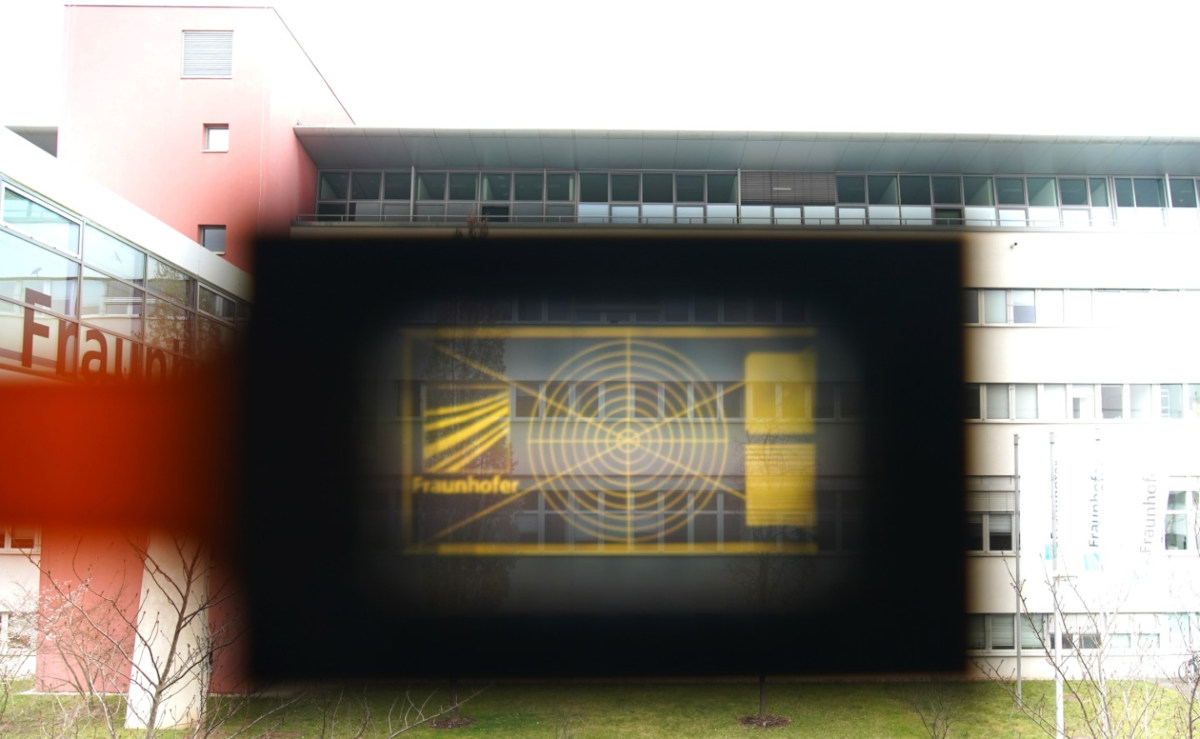
Fraunhofer institute : transparent OLEDs

Scientists at the Fraunhofer Institute for Applied Polymer Research IAP in Potsdam have succeeded in constructing transparent OLED displays using light-emitting polymers. Their brightness, operating life time and efficiency are so high that the first commercial applications can be envisaged. “We achieved this result by using a new type of metal electrode to supply the polymer film with electric current,” reports Armin Wedel of the IAP. “The clue of the transparency lies in its physical properties.” Earlier metal oxide coatings were too thick to allow enough light to pass through. But making them thinner reduces their conductivity and hence the luminescence and operating life time of the display.
Some new ideas are being investigated in collaboration with the University of Applied Sciences in Potsdam and the University of the Arts in Bremen. Transparent OLEDs allow conventional displays to be illuminated from the back or front. Once the manufacturing process even for larger surface areas has been mastered, it will be possible to incorporate the light-emitting polymers in laminated glass. The result would be, for instance, to transform car windshields or glazing elements in buildings into display panels that hardly interfere at all with their main function of letting in daylight or allowing a clear view out. Another novel idea are two-color transparent displays: The ability to mix colors permits the creation of entirely new effects and applications.

UDC Awarded DOE SBIR Phase II Contract for Solid-State White Lighting

UDC announced today that it has been awarded a two-year, $750,000 Small Business Innovation Research (SBIR) Phase II contract by the U.S. Department of Energy (DOE) to develop a novel white OLED light source featuring the Company’s proprietary TOLED® transparent OLED technology.
In this program entitled, “High Efficiency White TOLED Devices for Lighting Applications,” the Company is employing its proprietary TOLED technology to demonstrate a novel lighting concept with improved light extraction. In a conventional OLED, only approximately 25 – 30% of the light generated in the device is emitted to the viewer. Technologies to extract more of the light generated as useable light emission are important for achieving the performance required for OLEDs in lighting applications. During the Phase I program, Universal Display demonstrated a 20% enhancement in the amount of light extracted from an OLED by using the Company’s TOLED structure integrated with an external reflector. During this follow-on Phase II, the Company intends to optimize the performance of this novel design for white lighting applications.