 Universal Display (UDC) is an OLED research company, and one of the field's pioneers. UDC is involved in OLED IP, and holds many patent related to the commercialization of phosphorescent based OLEDs and also flexible, transparent and stacked OLEDs - for both display and lighting applications. The company offers both emitting and host materials.
UDC licenses its OLED production IP, and also sells OLED chemicals. UDC's customer list include Samsung, LG, Konica Minolta, BOE and others. In fact almost all OLED displays on the market make use of the company's emitters.
UDC trades in the NASDAQ (ticker: OLED).
375 Phillips Boulevard
Ewing, NJ 08618
United States
The Elec: UDC's blue PHOLED material is still unstable, may delay market introduction
Universal Display Corporation has announced several times that it is progressing with its blue PHOLED material development, and it is on track to release the first commercial material by the end of 2024. In November 2023 we reported that UBI estimates that Samsung has delayed the adoption of a blue PHOLED to the second half of 2025.
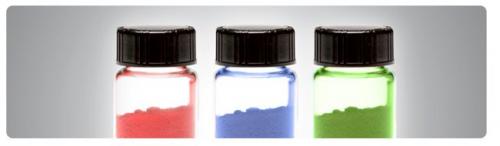 Now there's a new report in Korea that claims that UDC's blue PHOLED project is facing technical challenges, and UDC is still not able to achieve a long-lasting blue emitter at the right color point. It will be interesting to know whether UDC addresses this issue in its next investor conference call (May 2nd).


UDC reported its financial results for Q4 2023, sees a new cycle of investments in the OLED industry
Universal Display Corporation reported its financial results for Q4 2023, with revenues of $158 million, and a net income of $62 million. For the whole year (2023), UDC reproted revenues of $576 million and net income of $203 million. The company ended 2023 with $800 million in cash and equivalents, and has increased its quarterly dividend.
UDC says that the market still suffers from soft spending in smartphone and premium TVs. UDC, however, says that it believes that the OLED industry is starting a new and exciting multiyear investment cycle.
DSCC: the OLED materials market to grow from $1.7 billion in 2023 to $2.7 billion in 2027
DSCC estimates that the market for OLED evaporation materials (i.e. OLED stack materials) will reach $1.7 billion in 2023, and will grow to $2.7 billion in 2027 (a 11% CAGR from 2023). If UDC will succeed to commercially introduce a blue phosphorescence material, revenues can even be much higher.
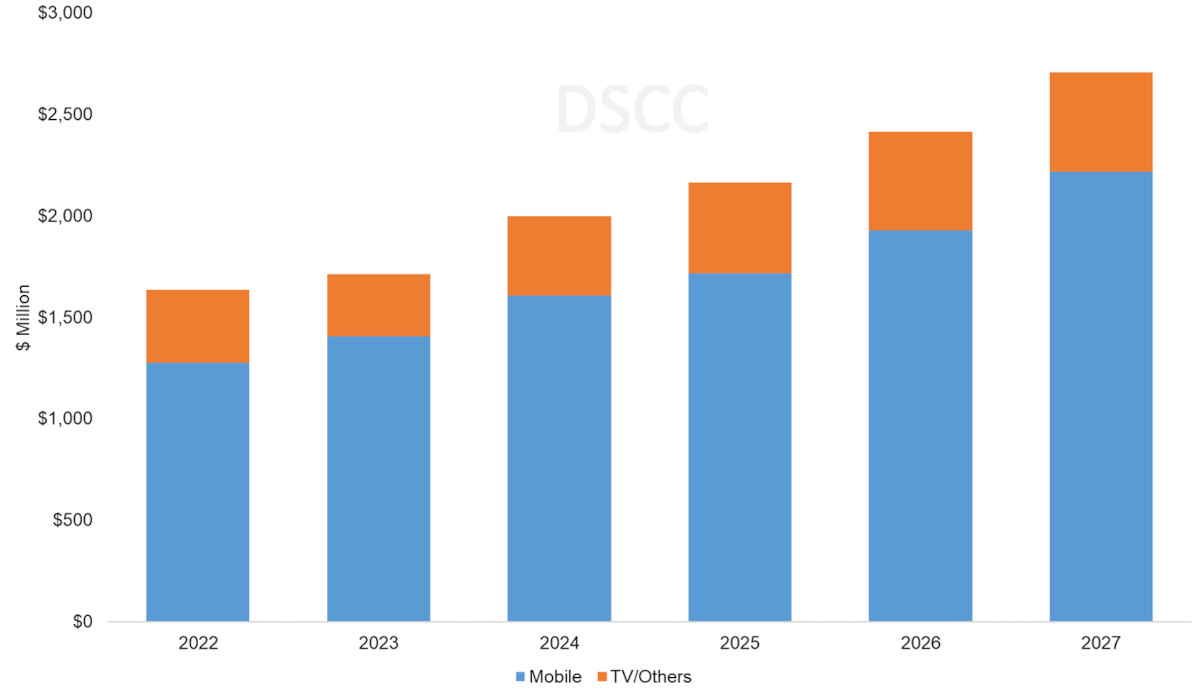
OLED materials used in TV applications (and other large-area applications) will grow from $305 million in 2023, to $492 million in 2027, a 13% CAGR. DSCC also sees very fast growth in material used to produce tandem-structure IT displays, which will grow at a 79% CAGR to reach $443 million in 2027.
Researchers from the University of Michigan develop a stable and efficient phosphorescence blue OLED using polariton-enhanced Purcell effects
Researchers from the University of Michigan developed a new OLED emitter system, based on a blue phosphorescence emitter, based on the polariton-enhanced Purcell effect. This new emitter systems offers high stability and high efficiency.
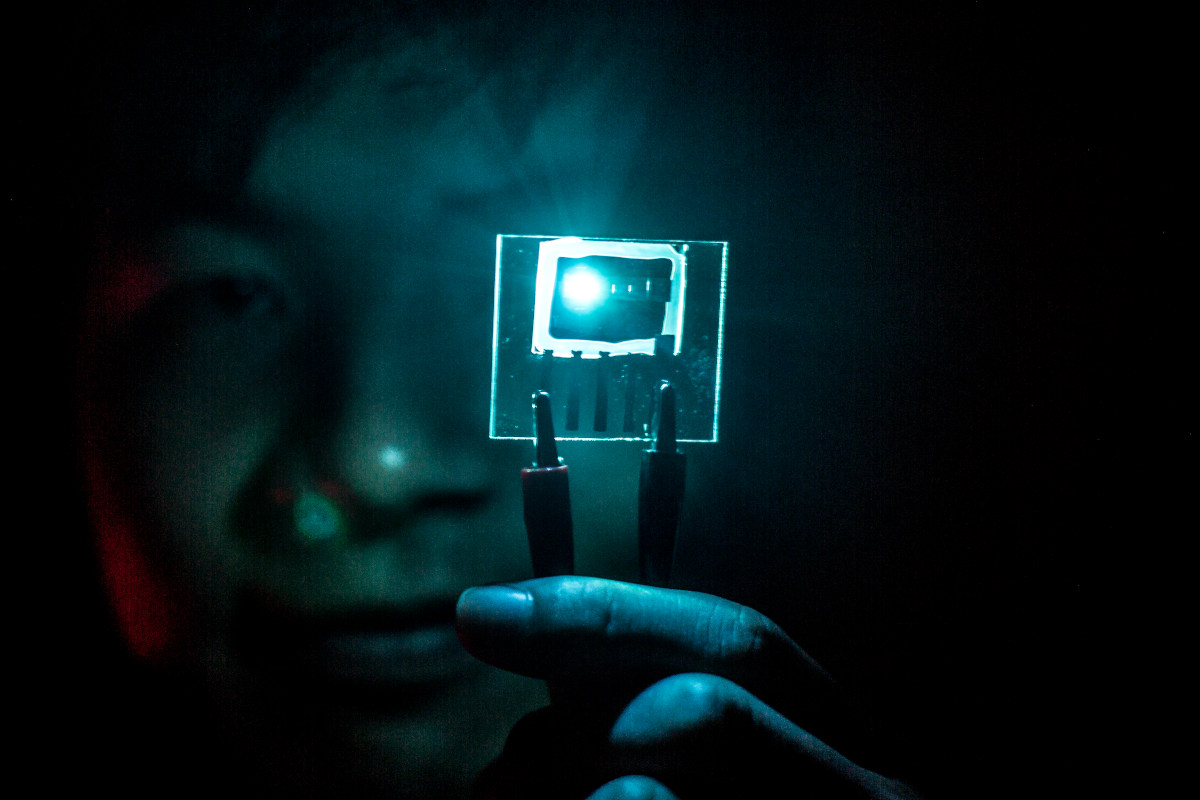
The basic idea is to start with a light-blue (cyan) phosphorescence emitter (which offers a longer lifetime than a deep blue emitter), and placing it between two mirrors. The distance between the mirrors is controlled so that only deep blue light waves persist and are emitter from the mirror chamber. The researchers also tuned the optical properties of the OLED stack to the adjacent metal electrode which introduced a new quantum mechanical state called a plasmon-exciton-polariton, or PEP. This new state allows the organic material to emit light very fast, thus even further increasing the lifetime by decreasing the opportunity for excited states to collide and destroy the light-emitting material.
Merck in dialogue: Next generation OLED materials
Merck KGaA is a pioneer in high performance OLED material development, supplying a range of materials for AMOLED makers since the industry’s inception.
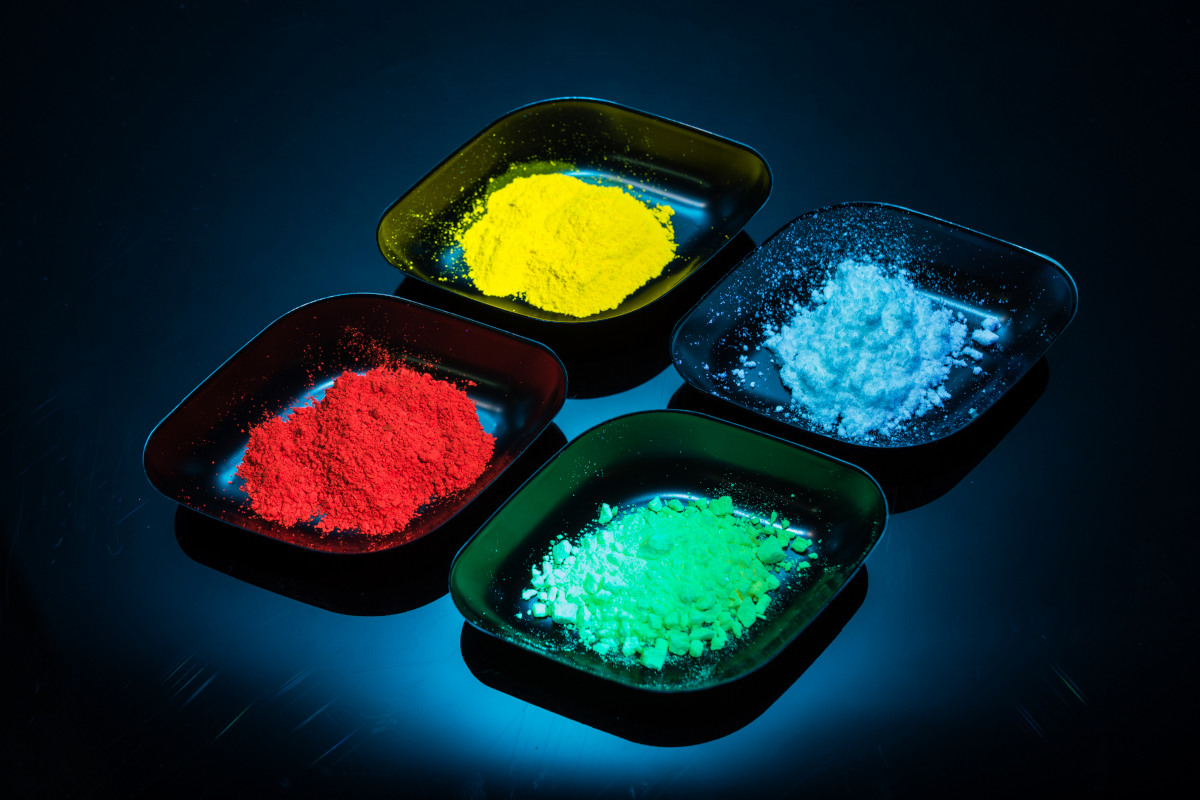
To learn more about Merck’s materials and views on the OLED industry, we conducted an interview with Dr. Georg Bernatz, Merck Electronics’ Global Head of OLED Technical Marketing. Georg Bernatz has received a PhD in Physics from the Philipps-Universität in Marburg, Germany in 2000. In 2004, Georg joined Merck, where, over the years, he worked in various functions and on various topics in the field of Liquid Crystals for displays. In 2018, Georg changed to OLED, leading OLED Physics Product Research, and in 2020 he became responsible for all Physics & Application Labs in Darmstadt for Display materials. Since October 2023, Georg is heading Merck’s Global Technical Marketing for OLED materials.
Hello Dr. Bernatz. Can you bring us up to date quickly on Merck's current OLED material products? What do you offer to OLED display makers?
Merck KGaA, Darmstadt, Germany is very active in the design, development and production of a broad variety of high performing OLED materials, with a strong focus on hole and electron transport materials (HTM, ETM), host materials for phosphorescent emitters as well as activities in the field of high efficiency blue.
UDC and BOE extend their PHOLED material supply and license agreements
Universal Display announced that it signed a long-term OLED material supply and license agreements with BOE Technology Group. This is actually an extension of UDC's previous agreement with UDC (which was signed in 2017). UDC did not disclose the financial terms.
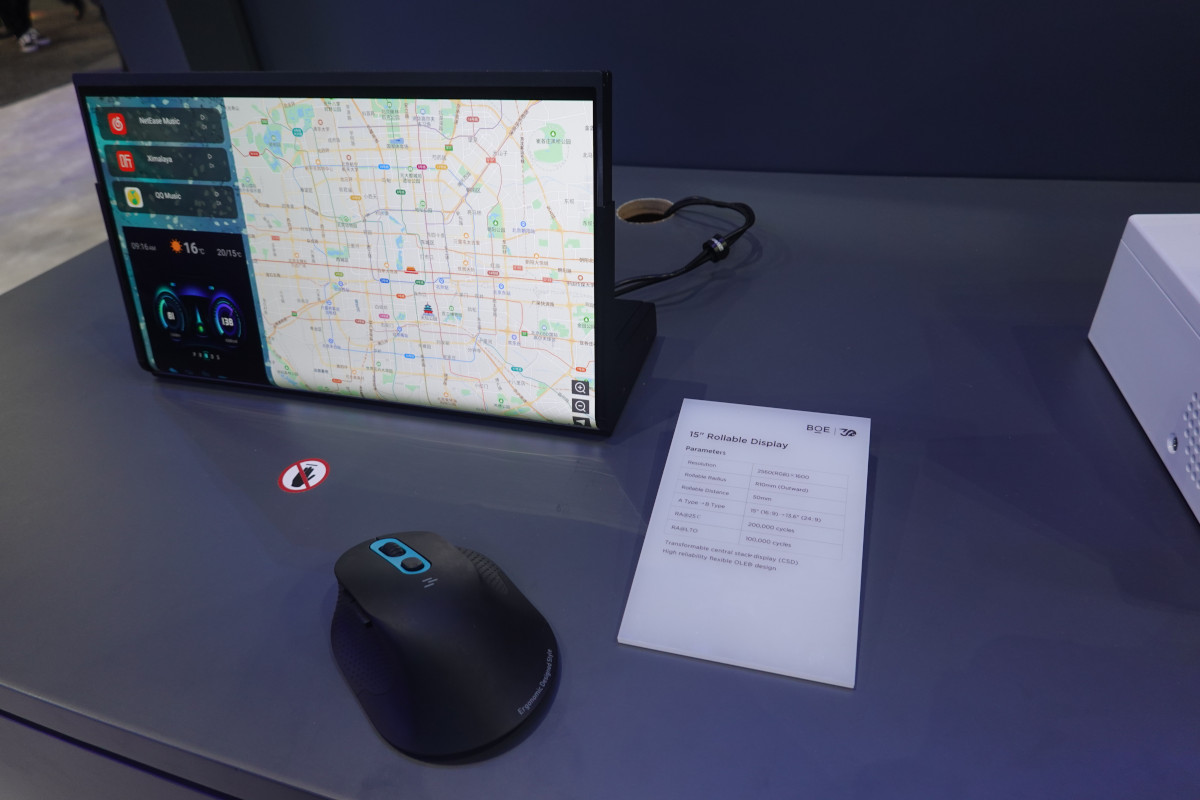
BOE recently announced that it shipped over 100 million AMOLED displays in 2023.
UBI: Samsung to delay the introduction its first blue phosphorescent AMOLEDs to the second half of 2025
Universal Display is progressing with its blue PHOLED material, and earlier this month the company said it is on track to introduce the new material commercially in 2024. During a company seminar, UBI's Daejeong Yoon updated that according to their latest information, Samsung Display has decided to adopt a blue phosphorescence material in the second half of 2025 - a year later than expected.
Samsung is calling the new material stack B1, and it says that the new stack will increase the efficiency of its OLED device by more than 65% (which seems to be rather too much, maybe it means 65% of the power consumption of the current stack). UBI says that the blue OLED still suffers from low lifetime - the lifetime of the blue PHOLED stack is only 55% of the lifetime of its current fluorescence-blue stack, but regardless of that the company will introduce it commercially due to the power consumption efficiency.
Universal Display reports its financial results for Q3 2023, is on track for a commercial blue in 2024
Universal Display reported its financial results for Q3 2023, with revenues of $141 million (down from $161 million last year) and a net income of $52 million (slightly down from 2022). At the end of the quarter, UDC had $779 in cash and equivalents, and the company updated its guidance for 2023, with revenues to be in the range of $565 million to $590 million.
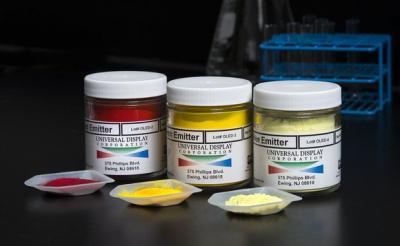
UDC is optimistic about the near future in the OLED industry, citing market reports that suggest increased demand and production for foldable smartphones and laptops, IT OLED displays, OLED TVs and automotive OLED displays.
UDC discusses its RGBB display architecture and its advantages in color reproduction and color gamut
During iMID 2023, Universal Display discussed the company's RGBB display architecture, highlighting the advantages regarding color gamut and color reproduction.The RGBB architecture basically adds a fourth OLED subpixel, a light-blue (or cyan) one to a standard RGB deep-color stack.
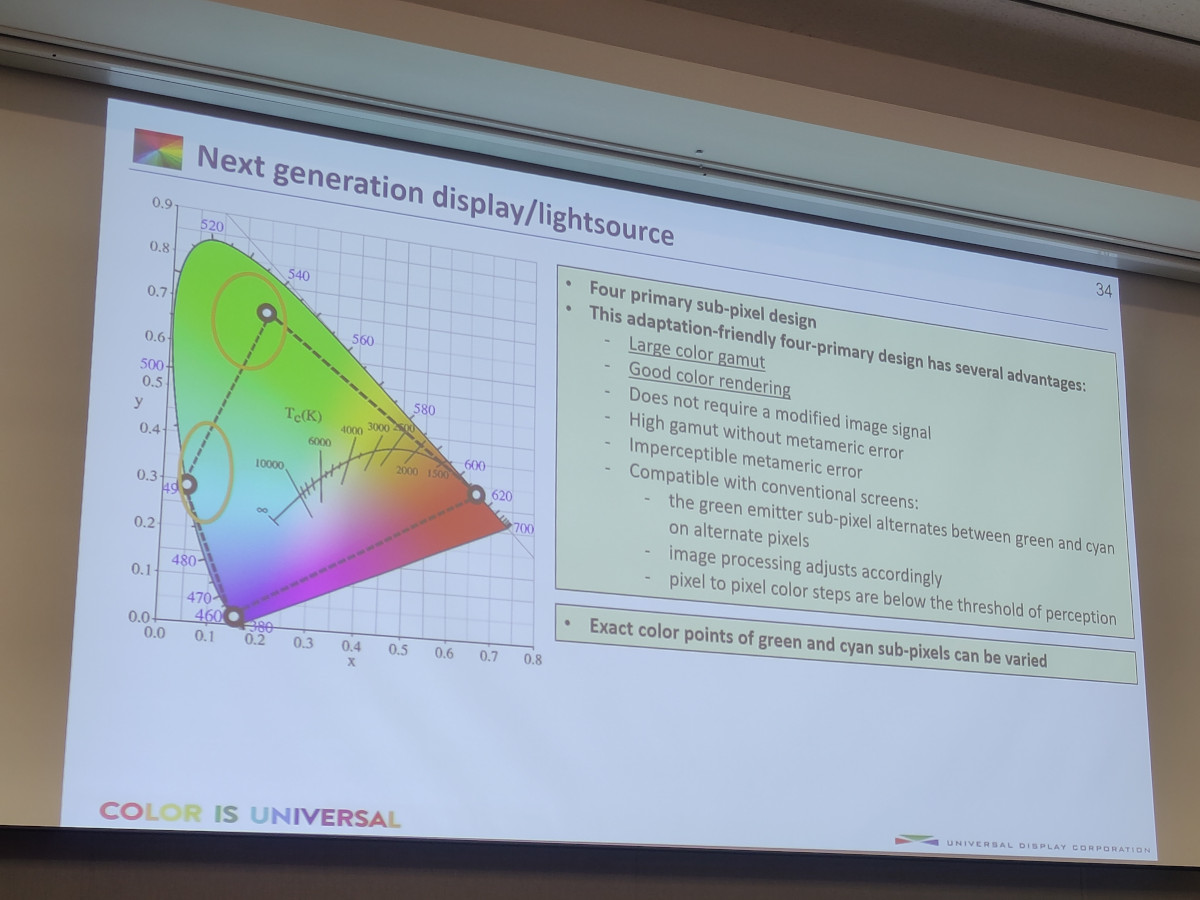
The current approach to achieve a large color gamut (UDC targets BT.2020) is to use emitters with a narrow spectrum, which enables high color gamut. But there's a catch - each person has a different color perception, and some people are less sensitive to certain colors compared to the "average observer". This causes a display that is based on narrow-spectrum emitters to suffer from distorted perceived colors.
UDC reported its financial results for Q2 2023
Universal Display Corporation announced its financial results for Q2 2023, with revenues of $147 million, an operating profit of $59 million, and a net income of $50 million.
UDC says it is still on track to introduce its blue phosphorescent emitter into the commercial market in 2024.