HMO

Apple is reportedly leaning towards sputtering for its next-generation HMO OLED backplanes

According to industry sources in Korea, Apple is leaning towards sputtering as the deposition method for the high-mobility oxide (HMO) backplanes it is developing for next-generation OLED panels. The final mass production process has not been decided. Samsung Display and LG Display are both developing HMO with sputtering as well as with atomic layer deposition (ALD).

Chart of oxide TFT electron mobility: conventional oxide around 10 cm²/V·s, an LG Display ALD prototype around 40 and the HMO target of 30-50, next to notes comparing sputtering and ALD deposition

ALD offers better control over the properties of the thin film, but its equipment and materials are expensive, so Apple is first examining whether it can use the cheaper sputtering process that OLED lines already rely on. "Samsung Display and LG Display are both prioritizing sputtering while also researching ALD," an industry source said. "The performance advantages of ALD have been confirmed at the research stage, but sputtering appears to be undergoing further testing because of cost considerations."


Read the full story Posted: Nov 03,2026

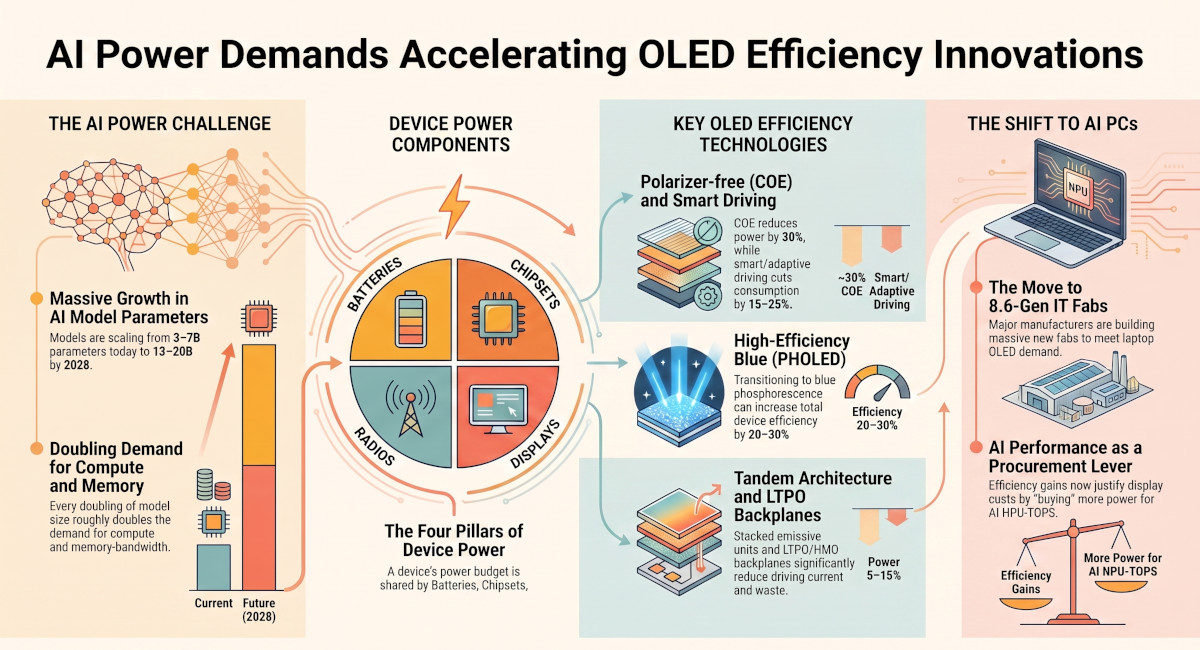
Will on-device AI pressure IT OLED developers to accelerate the adoption of next-generation OLED technologies?

In recent years, the main focus of the OLED industry was on reducing power consumption. OLED developers introduced several novel technologies, including new backplanes, materials and device architectures, to increase device and system efficiency.

This article looks into the potential pressure that the acceleration of on-device AI (locally running AI engines as opposed cloud-based AI) will have on OLED developers to reduce the power consumption even further, especially within the laptop segment, and adopt novel next-gen technologies.

Read the full story Posted: Aug 05,2026

OLED display backplanes, part 1 of 7: introduction & PMOLED

The display backplane is the grid of thin-film transistors (TFTs) sitting behind the pixels, switching and feeding each one. It is one of the major constraint on what an OLED display can do, and is also the component that actually consumes (or wastes, really) most of the energy, more than the OLED emitters themselves.

This article is the first in a new seven-part series that will offer a practical guide to the backplane technologies of today, and of the future. Across the parts we explain how each one works, how it is manufactured, which products use it, and where its roadmap is heading. The journey runs from the simplest displays of all to the most advanced backplane in development today:

Read the full story Posted: Jul 15,2026

LG Display said to accelerate its plans to convert some of its 8-Gen WOLED fab in Paju to eLEAP AMOLED production

Last year, we reported that LG Display is looking into adopting Japan Display's eLEAP technology at its OLED TV production lines in Paju, perhaps seeking to produce RGB AMOLED displays for IT applications at these fabs that are currently under utilized. In April 2026, we reported that LG Display is progressing with this plan, and is checking an investment plan to apply eLEAP into its large-area OLED production lines.

JDI eLEAP aperture ratio image

Originally we heard that LGD plans to make a final decision on the eLEAP introduction by the end of 2026, hoping to secure Apple as a customer for these IT OLEDs. According to the latest report from China, LG Display has already ordered the required equipment - and even began installing some of the machine, that will enable it to convert its existing 8-Gen WOLED production line in Paju to eLEAP AMOLED production.

Read the full story Posted: Jul 13,2026

AP Systems sees demand for next-gen OLED processes, develops ALD systems for HMO deposition and OCR inkjet printing equipment

AP Systems announced that it is developing next-generation OLED mass production equipment, as it sees opportunities in the OLED sector to introduce new production technologies.

AP Systems next gen OLED equipment slide

The first system the company is developing is a new Plasma Atomic Layer Deposition (PeALD) system, used for the deposition of High-Mobility Oxides (HMO) backplanes. HMO is sees as promising candidate for the next-generation OLED backplane of choice. 

Read the full story Posted: Jul 07,2026

HKC starts planning a 6-Gen OLED production line, approaches OLED equipment makers

Shenzhen-based HKC is reportedly progressing with its plans to build a 6-Gen OLED production line in Mianyang, Sichuan Province, and has started to approach OLED equipment vendors, seeking more information and quotes for production equipment.

According to the reports, HKC is looking to base this new fab on equipment it has acquired from Japan Display's Mobara OLED line, but increasing the capacity and adapting the technology by using new equipment to supplement the existing JDI systems.

Read the full story Posted: Apr 14,2026