OLED displays use organic materials that emit light when electricity is applied. OLEDs enable emissive, bright, thin, flexible and efficient displays. OLEDs are set to replace LCDs in all display applications - from small displays to large TV sets.
PMOLED: Passive Matrix OLED
PMOLED stands for Passive-Matrix OLED, which relates to the way you control (or drive) the display. A PMOLED display uses a simple control scheme in which you control each row (or line) in the display sequentially (one at a time). PMOLED electronics do not contain a storage capacitor and so the pixels in each line are actually off most of the time. To compensate for this you need to use more voltage to make them brighter. If you have 10 lines, for example, you have to make the one line that is on 10 times as bright (the real number is less then 10, but that's the general idea).
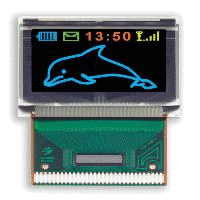 A PMOLED panel by Univision
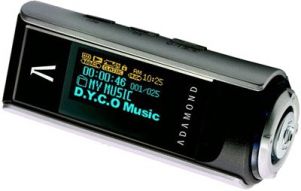
So while PMOLEDs are easy (and cheap) to fabricate, they are not efficient and the OLED materials suffer from lower lifetime (due to the high voltage needed). PMOLED displays are also restricted in resolution and size (the more lines you have, the more voltage you have to use). PMOLED displays are usually small (up to 3" typically) and are used to display character data or small icons: they are being used in wearable devices, small gadgets and sub displays
PMOLED vs AMOLED
The other kind of OLED display is called an AMOLED (or Active-Matrix OLED). An AMOLED uses a TFT that contains a storage capacitor which maintains the line pixels lit all the time (even though just one line is changed each time). AMOLEDs consume less power than PMOLEDs, have faster refresh rates and allows to build larger display with higher resolutions. AMOLEDs are also more complicated and expensive to fabricate.

AMOLEDs today are being used as displays for smartphones, digital cameras - and even OLED TVs.
Flexible and transparent PMOLEDs
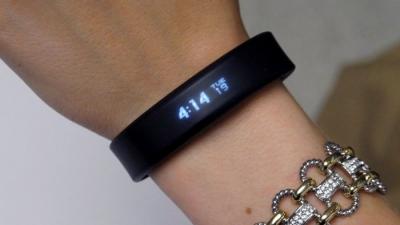
Some small and simple flexible (conformable) PMOLED displays are already on the market. Japan's Futaba for example is producing several such displays, including a 1.4" 128x16 film PMOLED display adopted in several fitness bands from Garmin, HTC and others.
Transparent PMOLEDs are currently in development, with some segmented panels already on the market - but as of early 2018, no dot-matrix transparent PMOLEDs are available.
Looking for PMOLED suppliers?
Are you looking to adopt an PMOLED display for your device? Today there are several PMOLED producers (mostly in China and Taiwan), each making their own kinds of standard and custom PMOLED displays, with a total of dozens of different displays on the market.
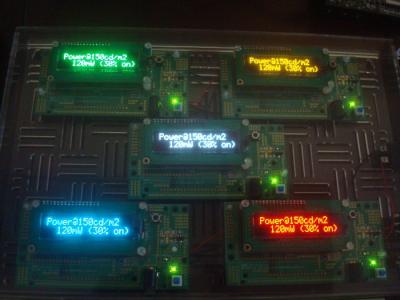
The OLED Marketplace is our very own comprehensive OLED catalog, in which you can find most of the PMOLED displays on the market. Click here to browse our extensive catalog.
The PMOLED Market Report
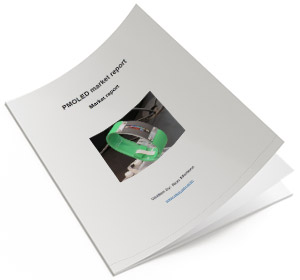
If you want to fully understand the PMOLED market and industry, check out our PMOLED Market Report. This comprehensive report explains:
- PMOLED production fabs
- Next-generation PMOLED technologies
- Flexible and transparent PMOLEDs
- PMOLED for automotive applications
The report package also provides datasheets and product catalogs and a detailed list of PMOLED producers.
Further reading
The latest PMOLED news:
Looking to buy OLED displays for your project? We can help!
OLED displays are rapidly gaining in popularity, and are already taking over various market segments like wearables and smartphones. However, for smaller scale projects it is often challenging to find the best OLED to suit the project's needs.
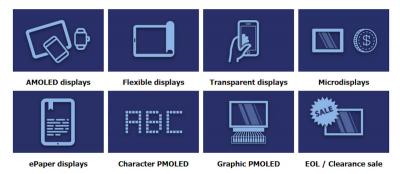
OLED producers usually only sell directly to very high volume customers, relying instead on distributors and suppliers for the rest of the market. This creates a fragmented market and makes it difficult to source the right display for your next device.
Luckily, our OLED Marketplace offers device developers a wide range of OLED displays, from wearable panels, through PMOLEDs and microdisplays to high-end flexible and foldable AMOLEDs. We believe this is the world's most comprehensive OLED catalog, which makes it easier to locate the perfect next-generation display.


Metalgrass offers a discounted yearly market reports package
Metalgrass (OLED-Info) is now offering a new subscription service for enterprises that want access to our complete collection of market reports.

For $3,500 per year, you will get an Enterprise License to all of our market reports. Metalgrass currently offers 12 market reports, plus 4 handbook guides, and all of these are included in the subscription (bought separately, these will cost over $10,000!). You will also have access to all new reports, updates and guides released in the future (during the yearly subscription period).
Our Enterprise License gives access to your entire organization: you can share the report with all the company employees via mail, shared server or any other digital way.
RiTDisplay and SmartKem join forces to develop OTFT-AMOLED displays
UK-based OTFT display backplane developer SmartKem announced that it has signed a joint development agreement with Taiwan-based PMOLED-maker RiTdisplay, for the production of OTFT-based AMOLED display prototypes.
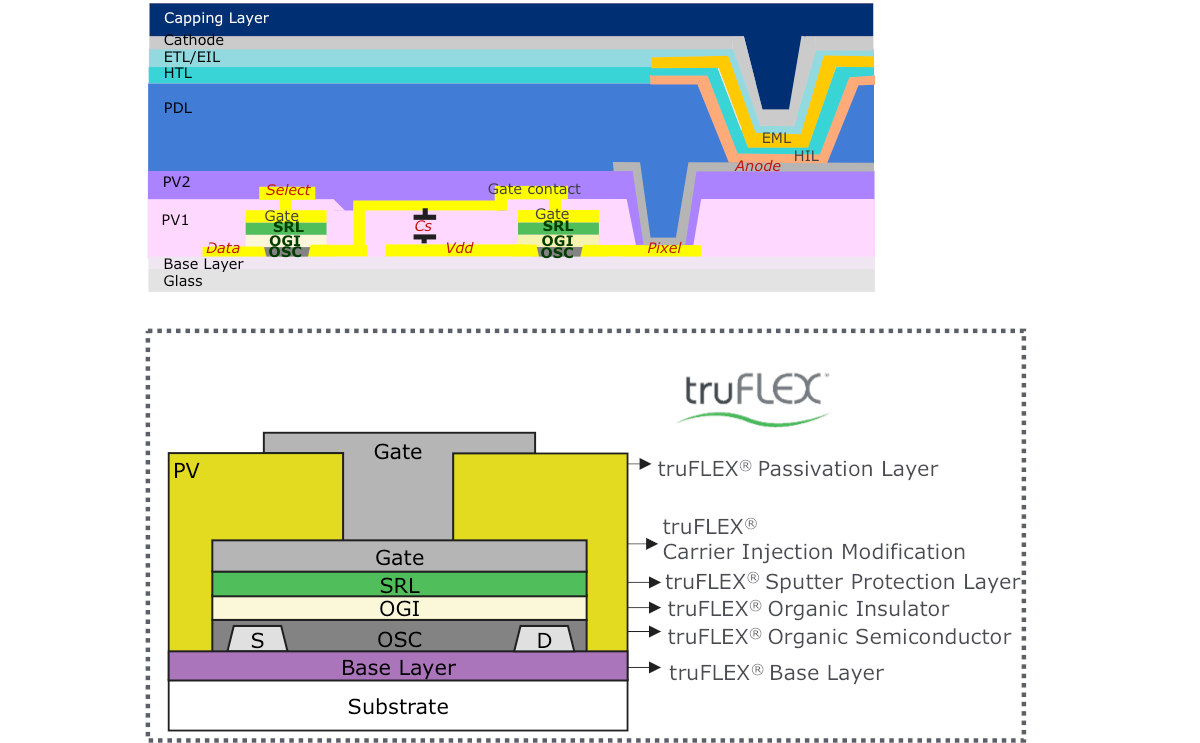
SmartKem's technology could enable RiTDisplay to produce AMOLED displays at a lower cost, and, more significantly, to use its own PMOLED production line without the large investment needed for an LTPS AMOLED Line. The current agreement includes a prototype display development, it will have to be seen whether it will be expanded in the future for actual production.
The worldwide component shortage is affecting the OLED industry
In recent months, the world is suffering from a serious semiconductor component shortage, due to several reasons that all seemed to have join forces - increased demand for IT products due to the pandemic, extreme weather conditions in the US and Asia, the US-China trade war, employee shortages, and the power grid problems that China is facing.
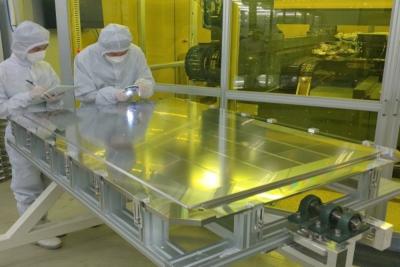
This semiconductor supply and demand crisis is affecting the global OLED industry. Some display makers cannot ship their displays - not because of OLED production problems, but because they cannot get enough driver ICs.
OLED-Info's OLED Market Reports updated to October 2021
Today we published new versions of our market reports - that cover the transparent, PMOLED, microdisplays and automotive OLED markets. OLED-Info provides comprehensive niche OLED market reports, and our reports cover everything you need to know about the niche market, and can be useful if you want to understand how the OLED industry works and what this technology can provide for your own industry. The reports are now updated to October 2021.
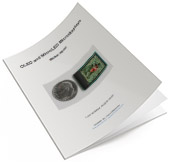
The OLED and MicroLED Microdisplays Market Report:
- The advantages of OLED and MicroLED microdisplays
- Information on all companies involved in this market
- What kind of displays are available on the market today
- Future technologies and roadmaps
The report package also provides a complete list of OLED and microLED microdisplays makers and their current (and future) products, and personal contact details into the leading microdisplays makers. Read more here!
OLED developments at the IIT's FlexE Center
The National Center for Flexible Electronics (FlexE) was established in 2014 as a Centre of Excellence at the Indian Institute of Technology (IIT) in Kanpur. The vision of the center is to "catalyse the development of domestic industry in the field of large area flexible electronics".
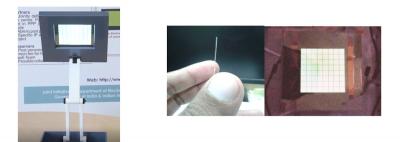
The FlexE center has some interesting OLED projects, and we recently had a discussion with researchers from the center to learn more about the OLED R&D activities.
OLED-Info overhauls its Automotive OLED Market Report
In early July, we published our quarterly update for our Automotive OLED Market Report. The update this time was comprehensive, as we overhauled the complete report.
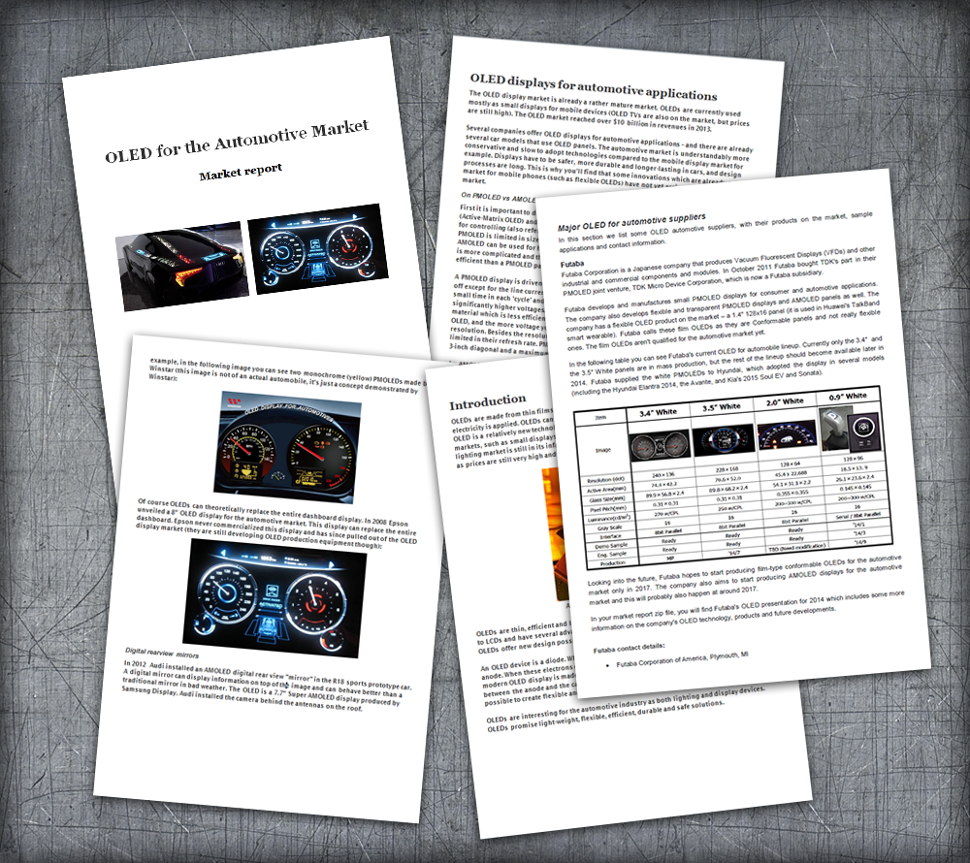
The OLED Automotive market is heating up. AMOLED displays (mostly flexible ones) are finally being adopted by commercial cars, while OLED lighting panels continue to be designed into high-end automotive taillights as the ultimate lighting solution.
OLED-Info's OLED Market Reports updated to July 2021
Today we published new versions of our market reports - that cover the transparent, PMOLED, microdisplays and automotive OLED markets. OLED-Info provides comprehensive niche OLED market reports, and our reports cover everything you need to know about the niche market, and can be useful if you want to understand how the OLED industry works and what this technology can provide for your own industry. The reports are now updated to July 2021.
The OLED and MicroLED Microdisplays Market Report:
- The advantages of OLED and MicroLED microdisplays
- Information on all companies involved in this market
- What kind of displays are available on the market today
- Future technologies and roadmaps
The report package also provides a complete list of OLED and microLED microdisplays makers and their current (and future) products, and personal contact details into the leading microdisplays makers. Read more here!
OLED-Info's OLED Market Reports updated to April 2021
Today we published new versions of our market reports - that cover the flexible, microdisplays and automotive OLED markets. OLED-Info provides comprehensive niche OLED market reports, and our reports cover everything you need to know about the niche market, and can be useful if you want to understand how the OLED industry works and what this technology can provide for your own industry. The reports are now updated to April 2021.
The OLED and MicroLED Microdisplays Market Report:
- The advantages of OLED and MicroLED microdisplays
- Information on all companies involved in this market
- What kind of displays are available on the market today
- Future technologies and roadmaps
The report package also provides a complete list of OLED and microLED microdisplays makers and their current (and future) products, and personal contact details into the leading microdisplays makers. Read more here!
Visionox spins-off its PMOLED business to a new company called Qingyue
China-based OLED maker Visionox has spun-off its PMOLED business, to create a new company called Qingyue. Visionox will now focus on AMOLED production (after having spun-off its OLED lighting unit Yeolight back in 2015).
Qingyue, which is one of the world's leading PMOLED makers, has two 370x400 mm production lines, each with a capacity of 8,000 monthly substrates (around 1.75 million 1 displays).