OLED display backplanes, part 5 of 7: LTPO, the hybrid backplane behind always-on and 1-120Hz displays

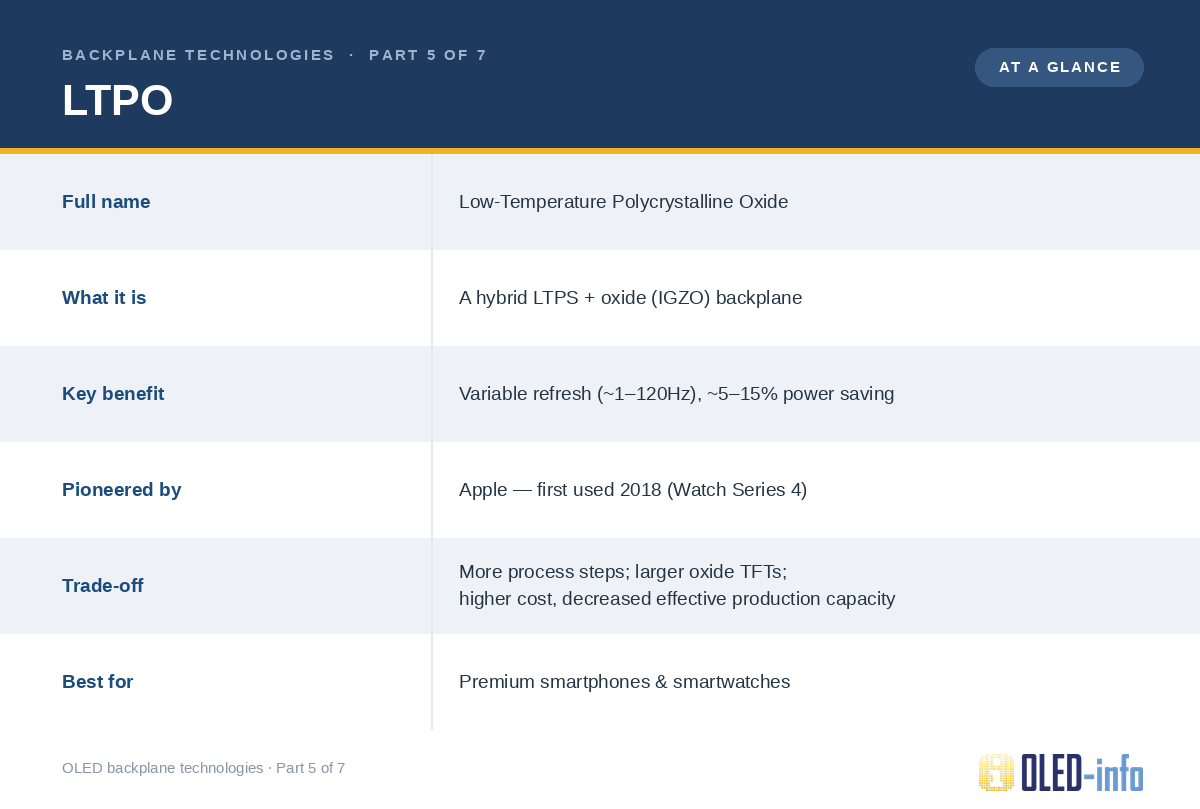
This is the fifth article in our OLED display backplane series. In the previous article, we examined oxide TFTs (IGZO), the transparent metal-oxide semiconductor that brought ultra-low leakage and large-area uniformity to OLED TVs and monitors. Here, we look at LTPO - the hybrid backplane that puts LTPS and oxide transistors on the same panel to enable variable refresh rates from about 1Hz to 120Hz.
Two materials, one backplane
Despite the name, LTPO - low-temperature polycrystalline oxide - is not a new semiconductor at all. It is a hybrid backplane that places both LTPS and oxide (IGZO) transistors on the same panel and uses each one where it is best. The idea was originally developed by Apple, which filed its foundational patents around 2014, and it has since become the defining backplane of the premium mobile display.
How LTPO hybrid backplanes work
The logic of LTPO is to assign each transistor the job it is suited to. LTPS, with its high mobility and CMOS capability, handles the demanding work: the driving transistor and the on-panel circuitry, where speed matters. Oxide, with its ultra-low leakage, handles the switching transistor, where the priority is holding the pixel's charge.
To read the entire article, sign up for OLED-Info Pro
OLED-Info Membership Benefits:
- Access to premium content
- A comprehensive guide to the OLED industry
- OLED Insights and trends analysis
- AI-powered assistant built specifically for the OLED industry
- A content library of 250+ brochures, catalogs, roadmaps, presentations and more.
- Detailed structured information on OLED devices, fabs, microdisplays, automotive applications and more
- Online access, easy subscription model, cancel at any time
- Only $199.99 per year (with group discounts)

