A few months ago Samsung said that the new Galaxy S3 has a Pentile display (a 4.8" 1280x720 HD Super AMOLED one to be exact) because PenTile increased the lifetime of OLED panels. I have discussed this with Joel Pollack, an Executive VP at Nouvoyance (Samsung's company that developed the PenTile matrix scheme), and he explains this claim further.
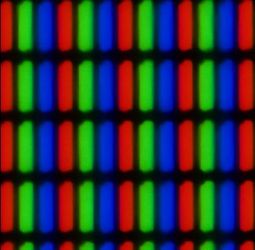 | 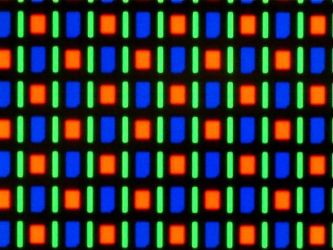 |
An OLED display is made from colored (RGB) sub pixels. A blue OLED has the lowest luminous efficiency (lower then red and green) and so needs to be driven at higher current - which means a lower lifetime.
In a PenTile display, there are only two subpixels per pixel, with twice as many green pixels than red and blue ones (see the image above). This enables larger sub-pixels, and a higher aperture ratio (or fill factor - the ratio of active area to nonactive area). This reduces the current density required to achieve a given luminance - which improves lifetime.
Joel says that in current OLED technology for a display with a resolution of more than 230 ppi it's hard for Samsung to achieve good lifetime without PenTile. At 230 ppi and below, actually, PenTile is not recommended (as the Pentile pattern is too visible), and indeed Samsung uses Super AMOLED Plus displays (which use real-stripe and not Pentile) in the 230 ppi range or lower.
Until blue OLED efficienty is improved, Nouvoyance expects Samsung to keep using PenTile for high density displays. Even if they do manage to produce 350 ppi displays soon, they may have to use PenTile still. Even when the lifetime is good enough for real-stripe, PenTile has an advantage in improved brightness.
Of course a lot of people do not like PenTile. The pattern is somewhat visible even at high resolutions, and this can be annoying for some people. Samsung is also being accused of marketing a "false" resolution. This does not stop Samsung's Pentile phones from being very popular though.
Comments
"In a PenTile display, there are only two subpixels per pixel as the green sub-pixel is shared by two pixels (see the image above)."
I'm not sure if it were the right wording. There are 2x green sub-pixels than red and blue. So it's rather the latter ones that are shared. Or, better yet: for every pixel, the red or the blue sub-pixel is omitted, alternately.
Hi,
Yes, you're right. That was a bit confusing, and misleading, and I fixed my sentence.


Do different colors in an oled display different current for lighting?
I thought oleds was polymers that light if current is on each subpixel and each color.
In former Clairvoyante Inc. PenTile RGBW nowadays with Samsung as owner of Clairvoyante and changed brand-name to Nouvoyante PenTile, that it is W=White subpixel in a RGBW-array that lights more bright.
UniversalDisplay have patented lB or light-Blue that shall work similar to W#=White in RGBW-array.
But now it seems that LG solution with backplane of Woled=White oled behind RGB-array makes
LG-display with WOLED in behind of RGB-array makes LG-Amoled displays with higher contrast than RGBW PenTile concept.