LG Display announced that its OLED TV displays has received two global gaming certifications. First up is a "Qualified Superior Gaming Performance" certification from British certification company Intertek, and the second is the "High Gaming Performance Gold certification" from German inspection service TuV Rheinland. LG Display says it is the first display company to receive these two certificates together.
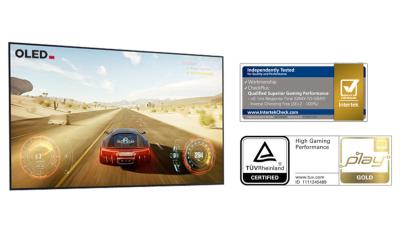
According to Intertek’s test results, the LG's OLED TV panels are the fastest display available today with a fast response time of less than 0.1 ms (0.0001 seconds) based on GTG (Gray to Gray) measurement method. In addition, OLED is found to be inverse ghosting free an issue commonly seen on LCD displays where previous image frames linger because they are simply too fast for the LCD displays to handle.
TuV Rheinland comprehensively measured the OLED panels’ capabilities which include testing on refresh rates, GTG response time, motion blur and color gamut, and afterwards rewarded OLED TV displays with their High Gaming Performance Gold status, the highest gaming performance certification to date.
Last year LG announced its OLED TV displays have been recognized for maximum eye comfort by leading global independent inspection service TuV Rheinland of Germany and UL, a leading global safety science company. In 2019 LG's OLED TV panels received an Eye Comfort Display certification from TÃœV Rheinland.
LG's OLED TV panels have received an Accurate Picture Quality certification from Intertek, an assurance, inspection, product testing, and certification company. In 2021, LG announced that its OLED TV panels obtained a 'Discomfort Glare Free' verification from UL, a leading global safety science company. LGD says that this is the first display ever to be recognized as a display that emits no glare.
LG also received received Eco-Product certification from Swiss-based SGS (Société Générale de Surveillance). A few months ago, LG detailed how OLED TV production is more environmentally friendly than LCD production.


"OLED is found to be inverse ghosting free – an issue commonly seen on LCD displays where previous image frames linger because they are simply too fast for the LCD displays to handle."
That is an incorrect definition of Inverse ghosting. For site such as this you should know better.
It would be correct, to some degree, for traditional ghosting, however not inverse ghosting.
Inverse ghosting is the result of pixels being driven to hard, or to put another way they are being given to much current and as a result are overshooting there intended target luminance.
Overshoot, usually caused by to high a overdrive setting, results in inverse ghosting. The effect looks like ghosting (smearing) but has a bright trail instead of a dark one.
Traditional ghosting is the result of pixels being to slow to hit their target luminance within the frame time and thus you can say "is the result of frame rates being to fast for the LCD to handle"