 Fraunhofer FEP (The Fraunhofer Institute for Organic Electronics, Electron Beam and Plasma Technology) is a research institute that focuses on innovative solutions in the fields of vacuum coating, surface treatment and organic semicconductors. The core competences technologies for the organic electronics and IC/system design are electron beam technology, sputtering, plasma-activated deposition and high-rate PECVD. The Fraunhofer FEP offers a wide range of possibilities for research, development and pilot production.
In 2009, the Fraunhofer IPMS launched COMEDD (the Center for Organics, Materials and Electronic Devices Dresden), as a venue to develop OLED lighting and OLED microdisplay technologies. COMEDD started as a department at IPMS, then turned into an independent Fraunhofer Institute in 2012, and later it was incorporated into the FEP. In 2024 COMEDD, which now focuses on OLED microdisplays, was moved back into the Fraunhofer IPMS.
Contact information for Fraunhofer FEP


Fraunhofer IPMS researchers develop a highly efficient WRGB OLED microdisplay on a 28 nm CMOS process
Researchers from the Fraunhofer IPMS have developed a new WRGB (WOLED) OLED microdisplay, based on a 28 nm CMOS process. The researchers say that this new display is highly efficient and features the smallest pixels to date.

The new display offers a 720x540 resolution - with a subpixel size of 2.52x252 µm² - to enable exceptionally high pixel densities of 5040 PPI. The flexible backplane architecture combines two driving concepts: frame-based (for continuous updates) and memory-based (for static content).
Karl Guttag: why transparent microdisplays are impractical for AR glasses
The following is a guest article by Karl Guttag of KGOnTech, a display industry veteran and one of the leading independent analysts of AR and VR display technology - and a good friend. We asked Karl why we do not see transparent OLED or MicroLED displays placed directly in front of the eye in AR glasses - and this is his detailed answer.
Introduction
Ron Mertens of OLED-Info, MicroLED-Info, the MicroLED Association, and one of the organizers of MicroLED & AR/VR Connect asked for my input on “Why is there no 'simple' solution, where we place a transparent display in front of the user [for AR]?” Or more simply, why aren’t ‘transparent’ OLEDs/MicroLEDs being used in optical-see-through (OST) AR headsets?
When evaluating OST AR solutions, we need to consider the following:
- Effect on the see-through image
- Darkening
- Distortion and uniformity (including diffraction) of the real world
- Artifacts such as diffraction light capture (so-called rainbow capture)
- Effect on the virtual image
- Uniformity in brightness and color plus image contrast
- Efficiency (power-in in Watts to light to the eye in nits)
- Forward Projection (“Eye Glow”) and other adverse social effects
- Cost, weight, thickness, and overall size
I often say that the most important measure of an AR display is how it behaves when the display is off (#1 above). As will be discussed, this is not possible with a so-called “transparent” display that is near to the eye.
Researchers at the Fraunhofer IPMS developed their highest resolution OLED microdisplay to date
Researchers at the Fraunhofer Institute for Photonic Microsystems IPMS developed their highest resolution OLED microdisplay, and will demonstrate it soon at SID Displayweek 2026.
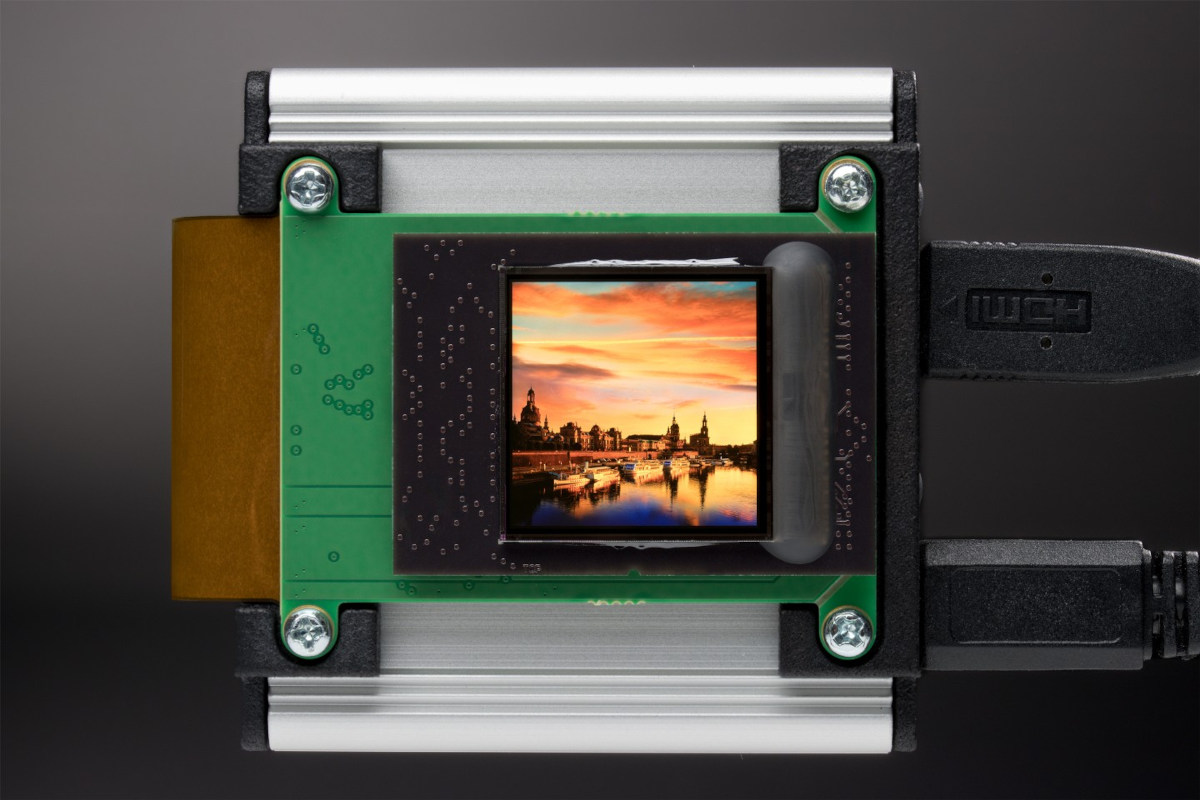
The display is a 1.07" 2048x2048 (9.3 um) RGB stripe OLED microdisplay, that is based on the institute’s proprietary high-voltage backplane circuit concept.

