 UK-based Excyton (previously known as PeroLED) was established in 2019 to develop novel light emitting materials, devices and architectures for next-generation displays. Excyton is currently focused on novel OLED display designs where OLEDs are stacked on top of each other and independently addressed.
TurboLED and 3D-OLED are examples of these novel OLED display designs:
TurboLED displays have independent stacked light and deep red, green and blue sub-pixels. The more efficient light red, green and blue sub-pixels are used for most image data (typically 90%), whereas the less efficient deeper red, green and blue sub-pixels are only used where needed. Excyton demonstrated that this can lead to display power savings of up to 50%, winning an innovation award for TurboLED at the I-Zone of Display Week in LA in 2023.
3D-OLED displays have independent stacked red, green and blue sub-pixels. The 3D-OLED pixel design has invisible sub-pixels with 3x higher resolution, 3x higher brightness and up to 9x longer lifetime than a standard side-by-side RGB pixel design used in OLED smartphones. 3D-OLED is also up to 3x more efficient than the RGBW pixel design used in OLED televisions or the White + Color Filter pixel design used in OLED microdisplays. Excyton demonstrated the World’s first OLED display with stacked red, green and blue sub-pixels, winning an innovation award at the I-Zone of the International Conference of Display Technology (ICDT) in Chongqing in 2026.
In 2020, Excyton received a $2 million seed investment.
Contact information for Excyton
Apple plans to introduce its first OLED iMac in 2029, LGD and SDC are already developing new architectures


Apple is reportedly looking to adopt QD-OLED or WOLED panels for its 2029/2030 iMac monitors
A spotlight on Samsung Display: the world's leading AMOLED producer
LG launches new branding for its tandem AMOLEDs and WOLED panels
Analyzing the past, present and future of QD-OLED architecture
QD-OLED is an OLED display architecture, that is based on single-color OLED emitters and color conversion using quantum-dots. This relatively complex architecture was invented years ago as a way to solve the challenges of large-area OLED RGB device deposition.

In recent years, we have seen successful full-scale commercialization of QD-OLED panels (by Samsung Display), but now in 2025, is there a place for this interestingly but complex device architecture? In this article we discuss the following topics:
- QD-OLED technology and architecture, its advantages and disadvantages
- Samsung's QD-OLED technology, and how it evolved in recent years
- QD-OLED projects at other companies
- Samsung's QD-OLED production capabilities, panels and products
- The future of QD-OLEDs technology
Spotlight on Universal Display Corporation, with investor bull and bear cases
Stacked OLEDs: past, present, and the bright future of multi-layer displays
Stacked, or tandem, OLED architecture involves integrating multiple OLED emission units vertically within a display panel, rather than just one as in traditional OLEDs. By stacking these layers, each can contribute to the overall light output, enabling higher brightness and efficiency – and also longer lifetime as each OLED device is driven at a lower current. Technically, a tandem device includes exactly 2 layers, but this term is now loosely used to describe any stacked OLED.
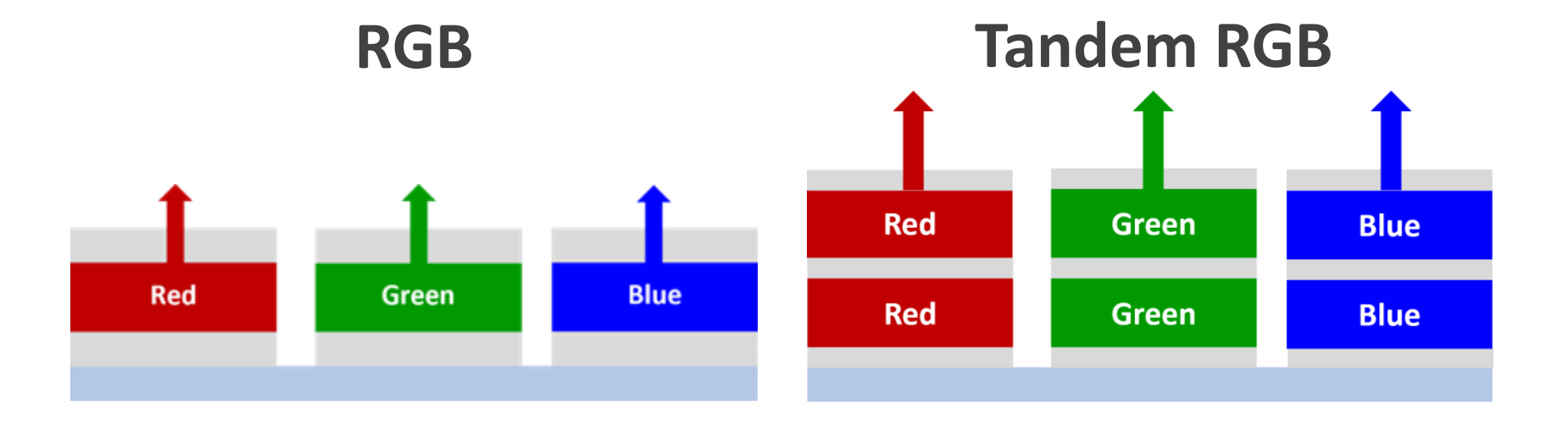
Standard RGB OLED stack, vs Tandem RGB stack (source: Excyton)
The stacked OLED structure is particularly valuable for applications where high brightness (including in HDR scenarios), efficiency (although this is not dramatic) and durability are essential – mostly IT devices (laptops and tablets), microdisplays and automotive displays. OLED TV panel makers have also adopted stacked architectures, but for slightly different reasons (which we will discuss below). Companies are developing novel stacked based architectures. In this article, we discuss:
- The advantages and disadvantages of stacked architectures
- The current architecture used by OLED panel makers
- The stacked designs of LG’s WOLEDs and Samsung QD-OLEDs panels
- The latest innovative technologies
- The future of the stacked OLED industry and markets

