Login | Register  

Novaled

Hodogaya Promotes Its Transport Materials for The Novaled PIN OLED Structures

Hodogaya Chemical and Novaled have agreed to offer hole transport materials for Novaled PIN OLED(TM) structures.

Hodogaya has exclusively developed specific Hole Transport Material for Novaled fitting very well with the Novaled PIN OLED structures. As a first result Novaled is enhancing its material offer with an additional hole transport material called NHT18.

The new NHT18 has a similar behavior in OLEDs like NPB, but provides additional advantages to OLED manufacturers. For example, the Tg of NHT18 is above 130C and thus gives a high temperature stability in OLED devices. The current efficiency in today's fluorescent blue emitting PIN OLEDs is 10% higher.

German researchers achieved record efficiencies for OLED materials

A research group of the Dresden Technical University (together with Novaled) has achieved record energy consumption for OLEDs. The achievement brings the organic LED technology closer to industrial volume production, and these OLEDs are prototyped at the Fraunhofer ITMS.

The research team achieved an efficiency of 26, 22 and 3.1 percent for red, green and blue organic LEDs which combined form a white light source. The low efficiency for blue results of physical differences — while red and green OLEDs are phosphorescent light sources, their blue counterpart is a fluorescent one, resulting in lower light emission. The difference, however, can be compensated for by increasing the active size of the blue light emitter as well as sending a higher current through it, explained research group member Rico Meerheim.

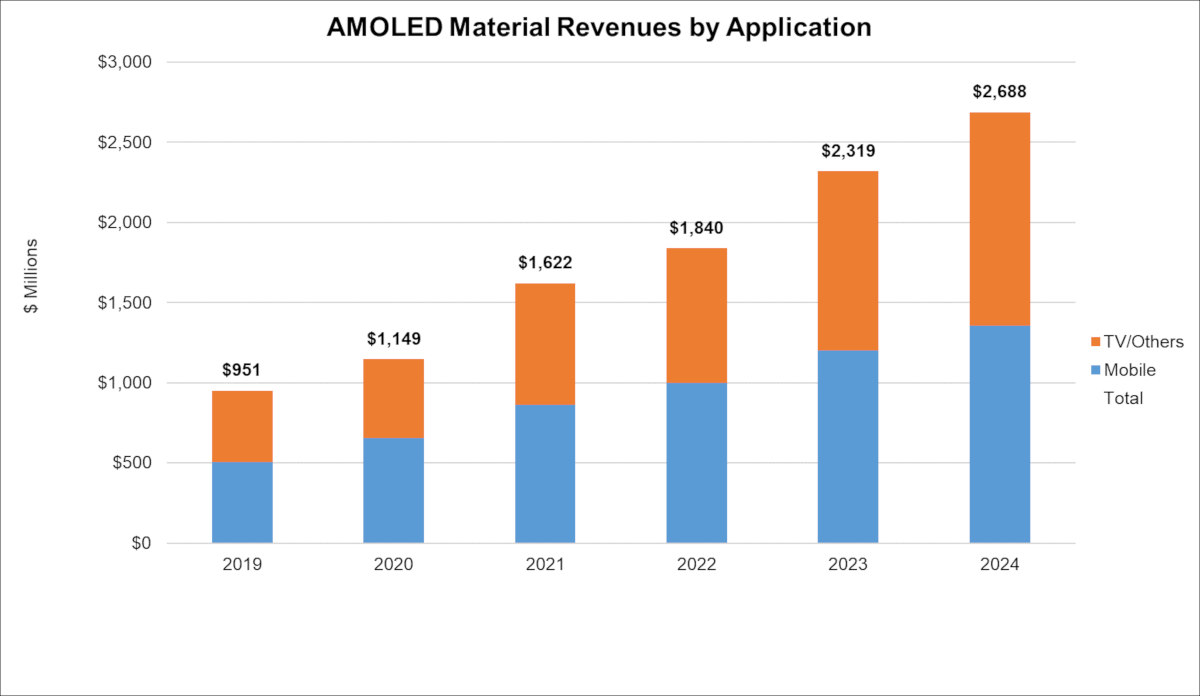
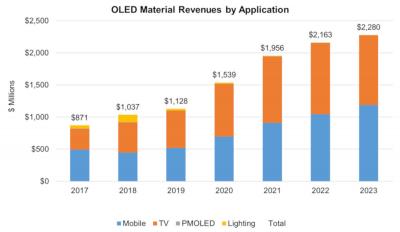
Nanomarkets: the markets for OLED materials will reach $2.7 billion by 2015

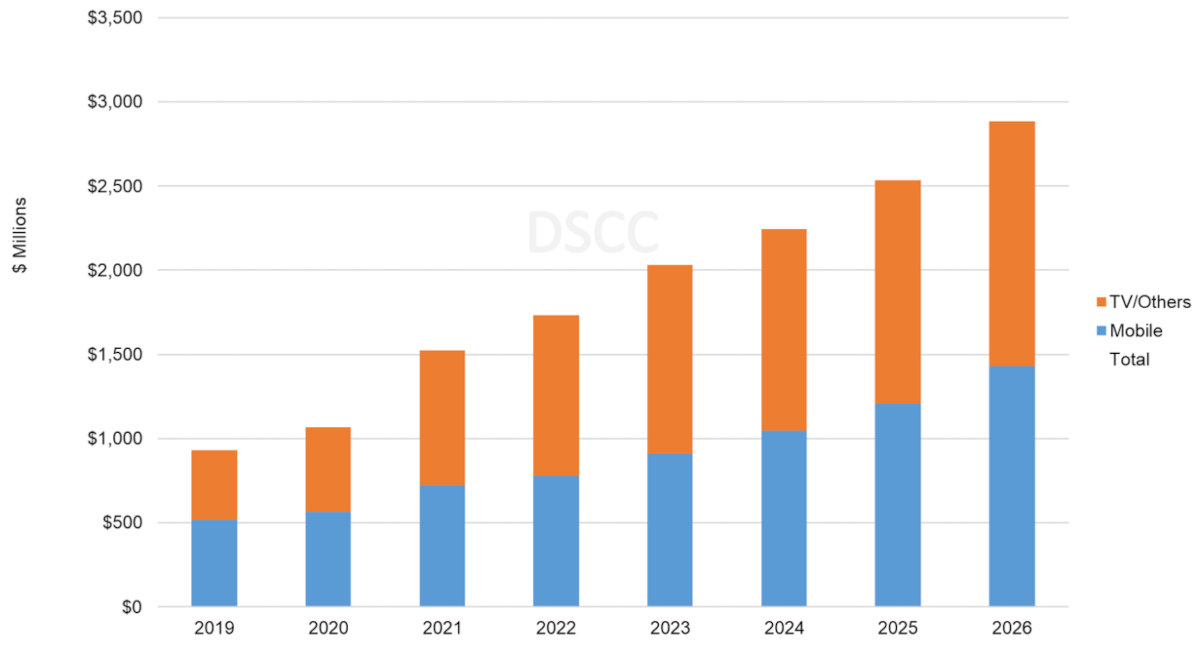
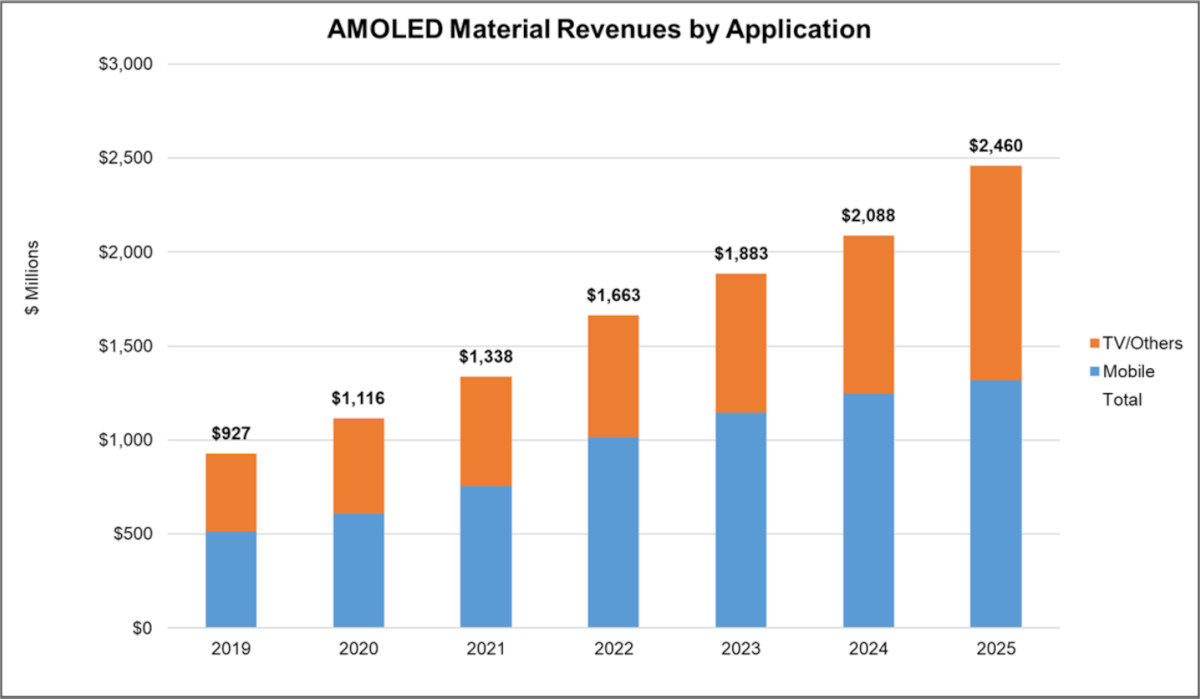
After receiving investments totaling billions of dollars over the past decade, the OLED industry is finally poised to take off. According to NanoMarkets, an industry analyst firm based here, the markets for OLED materials will reach $2.7 billion by 2015.

Vitex and Novaled Will Cooperate on OLED Thin Film Encapsulation

Vitex and Novaled are going to combine advantages of the Vitex Barix thin film technology with the Novaled doping technology and materials targeting very thin and high efficiency long lifetime OLED products.

The majority of OLEDs are currently processed on glass substrate and encapsulated with glass for protection against air and moisture. The glass represents more than 90% of the device thickness. Vitex has developed an innovative thin film encapsulation targeting ultra thin OLED devices.

OLED100.eu - a new EU OLED white light project to follow-up on OLLA, gets 30M$ funding

The companies behind the OLLA project (Philips, OSRAM, Siemens, Novaled and Franhofer IPMS) agreed to fund another OLED lighting project - the OLED100.eu, a follow-up project.

The new project will start on September 2008, for 3 years. The budget is 30$, 20M$ out of which will come from the EU.

The main objectives of OLED100.eu -

  • 100 lumens per watt power efficiency
  • 100,000+ lifetime hours
  • Area of 1 meter by 1 meter
  • Cost of 100 euro per square meter or lower


The OLLA project delivers its final milestone

At the end of the project period, the OLLA project consortium presents its final milestone: the basic technology for a white OLED light source, with an efficacy of 50.7 lumens per watt at an initial brightness of 1.000 cd/m² based on the Novaled PIN OLED technology. The OLLA project is a joint basic research consortium, headed by Philips Lighting.

The OLED technology is generating a novel and very attractive class of solid-state light sources, which are flat, thin, and very lightweight. Due to its freedom of design,

Notes from the OLLA final event symposium

The final symposium of the OLLA OLED lighting project took place on the High Tech Campus in Eindhoven Netherlands 12.6.08 with about 80 attending the exhibition and about 60 attending the half day conference. The objective is to start the work that will lead to replacement of many of the "6 billion lights that the world buys every year". Presentations from OLLA, Siemens, Novaled, Fraunhofer IPMS, Philips Lighting OLED Development and Royal Philips Electronics and the exhibition alongside revealed that the objectives had been met or exceeded. These objectives embraced laboratory demonstration of sharply improved life for 1000 cd/m2 emission and larger panel size etc, compared to what was available when the project was conceived five years ago.
Polymer OLEDs, despite being printable, were bypassed early on to concentrate on glass sandwiches of small molecule OLEDs.

CDT, Sumitomo Chemical and Novaled will collaborate to evaluate Novaled PIN OLED™ structures in Polymer OLED devices

CDT, Sumitomo and Novaled plan to co-develop hybrid OLED devices combining both new polymer emitting layers and doped electron transport layers. It is expected that these hybrid devices will offer further improvements in power efficiency without additional manufacturing complexity. The parties have reached an agreement on how IP generated during the JDA will be handled. Further, Novaled will grant a license to CDT enabling CDT to add necessary Novaled device IP to its existing and future licenses. Each company will remain responsible to market its own materials resulting from this co-development.

The OLED Association

There's a new OLED group that has just been formed - the OLED Association (OLED-A). The group is mananged by Barry Young (Former senior VP, Display Search).

There are ten members in the group - Cambridge Display/Sumitomo, Corning, DuPont, Kodak, eMagin, Ignis, MicroEmissive Displays, Novaled, OLED-T, Samsung SDI, and Universal Display, and OLED-A are working to add more members.

OLED-A will "provide the forum for solving common technology issues" and "developing standards for measuring and reporting performance" (materials will be an initial focus), as well as creating "a common marketing platform" to promote the cause to the display, solid-state lighting, photovoltaic, organic semiconductors, and other OLED-friendly sectors.

Novaled CEO: '100lm/W in 2 Yrs'

Techon has posted an interesting discussion with Novaled's CEO.

Highlights:

  • Our goal is to improve the luminance efficiency to 100lm/W, which, I believe, can be achieved in 2 years.
  • The key feature of OLED lighting equipment is the superior energy efficiency due to the high luminance efficiency
  • OLED is the direct evolution of LCD panels, not a revolution against them
Read the article here (Tech-On)