OLED-Info product reviews

TABOLA transparent and structured OLEDs now shipping, we go hands on

The Fraunhofer Institute first announced their Tabola OLED lighting panels back in October 2010, with plans to release them in Q1 2011. We haven't heard anything since (and I assumed the project was scrapped) - but last week I got a nice surprise in the mail: three sample panels (two transparent, one structured). The Fraunhofer are now producing sample panels and have actually started to ship these cool transparent Tabola OLEDs to customers now - which makes these the first transparent OLED lighting panels on the market. Read on for our hands-on review.

Philips Lumiblade OLED lighting panels hands on review

Philips released their first OLED panels (or Lumiblades, as they call them) back in April 2009, and in May they sent us a few panels for a review. Since then Philips released new panels, and last week they sent us a new "experience kit" with two OLEDs: a white dot and a white tall rectangle.

Lumiotec Hanger and Vanity OLED lamps hands on review

Back in June, Lumiotec announced a couple of new OLED lamps: the Vanity desk lamp and the world's cheapest OLED lamp, the $450 Hanger. Both use a single square OLED panel (we reviewed a previous generation panel back in September 2010). They were kind enough to send both lamps for a review, and after a few weeks of dealings with the Israeli customs, the lamps finally arrived and here's my review.

Both lamps use Lumiotec's Version-2 square OLED panels (14.5 x 14.5 mm active area) which feature a color temperature of 4,900K and a maximum luminance of 2,700 cd/m2. The panels are not very efficient at 10.5 lm/W (they use all-fluorscent OLEDs). The Hanger consumes 12 W while the Vanity consumes 13 W (the extra Watt is because of the electric touch sensor, more on this below). Here's our hands-on review of Lumiotec's Version-1 panels.

Blackbody V-LUX OLED desk lamp hands on review

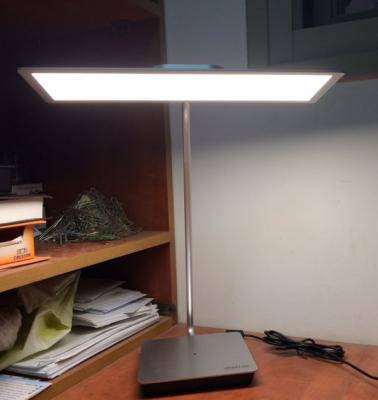
Blackbody announced their new Smart OLED lamp family back in September 2011, and they kindly sent us a V-LUX OLED desk lamp for a review. The V-LUX is an OLED desk lamp with two long rectangular OLED panels, designed by Bertrand's ID Medas. The V-LUX comes in 4 colors - gray, red, black and white - they sent me the black one.

Blackbody V-LUX with cactus

Each OLED panel is 100 cm2 in size, has a color rendering index of 80 and a color temperature of 3200K. The V-LUX consumes 2.8 W and its size is 35 (H) x 25 (W) x 46 (L) cm. The price is €572, you can buy it online here.

OPV powered flashlight - on hands review

The Organic Electronics Association (OEA) recently released their latest OE brochure, to which they attached a very cool demonstrator - an organic solar cell (PV) powered flashlight:

What feels like a bit of cardboard actually contains a a roll-to-roll printed organic solar cell, a flexible lithium-ion battery and a printed electronic circuitry. And of course a small white LED. The association says that this can "give you the feeling" of the next generation of electronics: thin, lightweight, flexible and produced at a low cost.

Lumiotec OLED lighting panel hands on review

Lumiotec started shipping their OLED Lighting kits back in February 2010. We were finally able to get our hands on one, and here's our hands-on review. We have already reviewed the Philips Lumiblade and the OSRAM ORBEOS panels, and we'll compare them all in this review.

APUS OLED watch review

The nice guys over at APUS have kindly sent me an OLED watch for review. This is their Alpha Dark Force, which uses a blue PMOLED (they have other watches that use red or white PMOLEDs). APUS are selling the phones on-line in their web shop. The watches are also available in Amazon.com. The Alpha Dark Force, shown above costs $129.

APUS OLED watch photo

First impressions

When you first take it out of the box, you notice something strange - the display is off. Then you realize that that's how it's supposed to be - the watch does not display anything until you press a button. Then it shows you the time for a few seconds, and turns off again. APUS say that this is to preserve the battery, which will drain in a couple of days if the display will be always on. More on this later.

Osram ORBEOS OLED Light hands-on

The kind folks over at Osram has sent us one of their new ORBEOS OLED Lighting panel for a review. The ORBEOS is a round (88mm diameter) glass panel that's only 2.1mm thick (it weights 24g). The efficiency is 25lm/W. The brightness of the panels is 1,000cd/m² with power input of less than a watt, and they should last around 5,000 hours. The panels are available now via OSRAM's site, they cost €240 each. The panels were actually released back in November 2009, and OSRAM say that they are happy with the sales and interest so far.

OSRAM ORBEOSOSRAM ORBEOS

Read on to see my impressions of this OLED panel, and how it compares to Philips' Lumiblade panels which were the first available OLED panels...

Philips Lumiblade white OLED

A few weeks ago, Philips sent me a couple of Lumiblade OLED panels to test - a blue square, and a white 'freeform'. Unfortunately the white one had some defects. So they sent me a new white panel, this one a square. It's the same size as the blue square. Finally I have a real OLED light lamp - a white one... The OLED driver that I have can only connect to one panel (when you actually buy these from Philips, you get a 4-panel driver. So I couldn't take a photo of two panels together.

Philips lumiblade oled white square photo
 

Philips lumiblade OLED light - first looks

Update: Philips sent us a new white OLED square, here's our hands-on review of it

The kind folks from Philips have sent me a couple of OLED light panel samples to review. Philips have started to offer these panels online, but you can't actually get them yet. The kits are not ready, and the one I got was without a proper box and manuals. As this is just a lamp, really, it's pretty simple to use. You get a driver-box, that's got a dimmer and an on/off switch. I also got two panels:

  • Small rectangle in blue color (Height 43.7mm, 47.4mm)
  • White freeform (height 39.4mm, width 73.1mm)

The first thing you notice is how thin these panels are. It is amazing at first to have a light source so thin. After a while you get used to it, and now it seems strange that normal lamps have to be so big! Once these kind of lights are available, I'm sure no one will want to go back...

Philips lumiblade oled kit photo Philips lumiblade oled kit photo 2


The freeform one has a lot of 'speckles' on it. It turns out that it got damaged in the shipment (or perhaps Israeli customs, who handled it and opened it, are to blame). Philips promised to send another white panel, so I'll be able to post new photos in a week or so. UPDATE: Philips indeed sent me a new, working white OLED square... 

Those panels have 1,000 cd/m2 brightness, are up to 20 lm/w in efficiency, and Philips say that the lifetime is 10,000 hours. They are also very thin - 1.8mm in fact. Here's how they look when lighted:

Philips lumiblade oled blue square and driver photo Philips lumiblade oled blue square photo Philips lumiblade oled blue square photo 2
Philips lumiblade oled blue square photo 6 Philips lumiblade oled blue square photo 5 Philips lumiblade oled blue square photo 4
Philips lumiblade oled blue square photo 3 Philips lumiblade oled white freeform photograph Philips lumiblade oled white freeform photo

The panels are not very bright, and you need several of those panels to create a lamp. In fact when Philips showed their table lamp design, it had more then 10 panels. So if you're thinking of ordering those for a test, be sure to order enough.

OLED News and Information Copyright 2004-2012 Metalgrass software